Just over 2 years ago, I posted an expansion plan for Disneyland Park Park, where I proposed a few major hypothetical changes to the already great park. And now today I have a version 2.0 that improves on that design.
In the original post, I discussed how much I love the existing park. I was only there a day, but that day left an impression. Frontierland has one of the best overall stories and themes of any land I've been to, Fantasyland is by far the most beautiful example of the type, Main Street is impeccably detailed and lifelike, Adventureland has one of my favorite exploratory areas, and the original Discoveryland aesthetic and concept is just the best ever. More discussion about why the park is great in the original post.
So with an expansion plan like this, the idea is not really to fix the existing park, but to add more to it that hopefully complements whats already there. There are really only a few places that this park can expand, so this plan is a little similar to the previous one. A few of the additions from last time are retained, and the rest of them are replaced with a new idea. So now we will talk a walk through the park, pointing out my proposals.
Just like last time, Main Street is completely unchanged. No way to improve that. Special plug for the great Arcades. Go explore those if your there.
The main area of Frontierland is also unchanged. Its great that the land has recently gotten some attention with the refurb of Big Thunder Railroad and the Rivers of America.
The area farther along the River, by the existing theater, is the first area I changed. When I visited, this area was completely empty because there really was no draw, so I feel like it could benefit from some permanent additions.
My proposal is an American National Park setting, similar in a way to the Camp Woodchuck additions to Tokyo Disneyland, but as a whole land that specifically features the Country Bears. The Bears own and operate the park as a vacation retreat for all their animal friends, so this land can thematically include the large catalog of animal based Disney properties. The setting and style is decisively North American with architecture based on the Yellowstone Lodge style.
The rustic redwood camp setting transitions as we pass through a denser forest just past the Big Thunder load building. Straight ahead through the brush is a sprawling fort in front the gentle stream. The fort, which is based on the Redwood Creek Challenge Trail from DCA, is accessed to the left, where there is also the existing canoe dock, themed to fit in the land. The fort top offers the best view over the river and the land below.
Crossing the stream leads to the rest of the land. To the left is a version of Junkyard Jamboree, nestled along the river. The vehicles are ranger jeeps that have been repurposed into the thrilling attraction. Adjacent is the existing theater, where animal specific themed shows are presented. Something like Forest of Enchantment with a bit of a Country Bear National Park plot frame would be perfect for the area. The Cowboy Cookout building remains but is redressed as the rustic Camp Mess Hall and the interior and menu are adjusted to match. And finally, next to the train station, is the main attraction, a mid-scale musical dark ride. The building through the trees is a Park Lodge where we set off on a tour of the National Park, guides by the Country Bears themselves. This would be a musical adventure through a world of animals and plants, reflecting the adventure of the great outdoors. This is the same attraction I proposed for DCA.
The next change is up in the expansion area of Adventureland. Again, the main part of Adventureland is unchanged, except the Indiana Jones coaster is removed in favor of my proposed Indiana Jones ride in the Studios park. Replacing this and the expansion pad are two attractions, completing the loop back to the Pirates area. This area is all themed as an African jungle as opposed to the Caribbean and Arabian areas in the rest of the land.
The first is a concept for an indoor replacement for the Jungle Cruise idea. Last time, I tried an actual indoor Jungle Cruise, but I don't think that really works. So instead, here I am suggesting an indoor jeep exploration attraction that uses the Test Track/Radiator Springs ride system. That would allow for both slow attraction show scenes, passing similar gags as the Jungle Cruise, and more fast paced and rough exploration moments through the dangers of the jungle. It would be entirely indoors, unlike the other versions of this system. The load is in an open cave facing out into the land. Additionally, the train would look into the jungle for a quick moment on the back side of the show building, seeing the jeeps pass by.
The other attraction is a Tarzan themed family coaster, something lacking from this park. The two existing coasters are pretty intense, so I felt like something tamed down but still fun would be a good option. The entrance is at the base of a second fake treehouse for the land, this one much smaller, not explorable, and directly based on the ship built treehouse from Tarzan. Ship wreck fragments surround the area, as well as a series of canvas tents, left over from the events of the movie. We load on the upper level of the main tent, and then swiftly speed into the show building. First there are a series of show scenes through the world of Tarzan, Jane, and Turk, and then the coaster portion, which is mostly outside.
The other change to Adventureland is less of a change and more of a return to the original: The Pizza Outpost once again gets talking animatronic birds in the dining rooms, creating a facsimile of the Tiki Room.
Fantasyland has a few additions. The Frozen subland to the north that I proposed last time remains (attraction post here!) as well as the addition of a meet ans greet center in the open spots on the east side of the castle. Around the corner from Small World are two new dark rides.
I has a lot of internal debate for the theme of the first, using the plot across the parade path. But my decision came by realizing I should maintain the geographic distribution of Fantasyland. If you have not noticed, all the existing buildings are grouped by region, which makes a lot of sense for architectural consistency. British Tudor area to the far west, Germany on the west of the castle courtyard, France to the east, Scandinavia with my Frozen addition to the north, and Italian on the far east side, where my addition is. The Pizzeria Bella Notte is definitely a group of Italian styles. Unfortunately, there are no Italian Disney IPs. So I adapted to Mediterranean and decided to propose a Hercules dark ride. That's a property that is under utilized in the parks, so I decided it would be a great idea. The facade would be a Greek Marketplace, attempting to echo the Italian style across in any way possible. Inside is a very traditional musical dark ride, guided by the Muses.
And finally, I am proposing another dark ride in the expansion area outside the berm, anchored by a tall and spindly green beanstalk spanning over the train track. This is obviously a dark ride for the future film Gigantic. This film is based in Spain, also a Mediterranean locale, so I am hoping this could be a complementary style to the area. The entrance path leads under the stalk and the train track to a small village facade and the attraction inside. This would be a much larger dark ride, potentially trackless, through the world of the film. Since it is not out yet and we don't know much, that's as specific as I can be.
The last land, Discoveryland, might have the most changes, but again, not to change the original vision, but to restore it. The concept of the future as imagined by the past is such a cool and unique idea, but like all Tomorrowlands, it is too easy to melt away. I proposed Star Wars for the Studios park intentionally so that I could remove it from this park and go back to the Jules Verne inspired idea.
So first, Buzz Lightyear is removed because it clashes theme and style and replaced by a Time Machine inspired dark ride, using the same Omnimover track. The idea would be to present a fun and colorful journey through some significant times and settings of Europe.
Next, inside the Videopolis, a dark ride is added to align with the theme of the Cafe Hyperion. The bulk of the theater is converted to show space and there is a bit of an addition to the north, all holding a suspended dark ride telling the story of Around the World in 80 Days. Part of the theater remains as the seating for the restaurant, and the balloons load and float along above the seating before starting the adventure.
Space Mountain becomes its original concept and the Autopia is unchanged. Across the land, the current Les Mysteres du Nautilus walk through, which was fantastic but seemed unpopular, becomes the queue to a new attraction. The attraction is a Circumotion Theater attraction by Falcon’s Treehouse, which is a theater in the round simulator under a domed projection screen. Guests load into one of the two Nemo designed observation submarines for an exciting trip to the bottom of the sea. Above, we have a fantastic view into the wonder of the ocean before our required squid attack that jostles us around.
Last, the far east expansion area across the train track is used for another sub land that's a bit different from the rest of the land. Space travel is a common Tomrrowland/Discoveryland theme, but not exploring another planet, so I thought that could be an interesting area.
The existing simulator attraction, currently Star Tours, becomes the launch station of a fictional Verne inspired space agency. Maintaining the style of the rest of the land but a bit more modern, the simulator attraction launches us from Discoveryland straight to a base on Mars, which is the rest of the land. The exit of the ride takes us into a the interior of a futuristic but still Verne inspired base. This is a bit of a fantasy version of how we would travel to and live on Mars, so it matches the adventurous spirit and fun of the rest of the land. There is also a second entrance to the land behind Space Mountain.
Outside the domed buildings is the main area of the land, an enclosed red and rocky valley. Outside in the valley is a Jetpack spinner, like the one in Shanghai and a couple other buildings built into the landscape of the planet. The other main building across the valley is the entrance to the main new attraction, a rover attraction on the surface of Mars. The attraction would use a similar system to the EMVs of Indiana Jones, so that it could travel up and down elevations, drive over rough terrain, and have a relatively hidden track ahead. It would be a completely different vehicle modeled on real Mars rovers. The trip would start simple with exploration across the rough terrain, then journey into a lava tube and down into a undiscovered cave. Since this is a fantasy take on the concept, we ultimately encounter what appears to be an alien civilization underneath the planet.
Last, there is a final time travel show scene for the train, transitioning from the Discoveryland aesthetic back to Main Street.
And back to Main Street, and that is everything I have!
So that is my second version of Disneyland Paris Park. I think it is an improvement from the last version and I am glad that I got to try some things out.
Let me know what you think with a comment! And follow me on Twitter to keep up with progress. I tweeted a few quick polls during designing this to get quick feedback, so follow so you can catch those next time!
Not sure what will be next up for either the text post later this month or next months design post, but maybe I'll let you know soon.
Showing posts with label Disneyland Paris Resort. Show all posts
Monday, March 13, 2017
Tuesday, January 10, 2017
The Indiana Jones Adventure: Lost City of the Gods
or the Raiders March on Youtube
The year is 1937, soon after the events of Raiders of the Lost Ark. Inspired by his recent successes, Doctor Indiana Jones has been brought to the city of Rome to unearth a long lost ancient temple, buried layers deep in the catacombs and caves below the historical city. Legend has that the temple is part of the first Roman city and may hold artifacts thought to be lost to history as well as the grand treasure of the international Roman Empire. He is not the first to attempt this search, but his skills and experience may just make him the most successful.
Indiana Jones and his team have come to a Basilica on the edge of the city, long thought to mark the entrance to the lost realm. They have excavated the ruins below the 12th century church to uncover the mysterious remains of an earlier 4th century church. But there is still more to explore, as the team has opened up a tunnel into the complex catacomb system below, stretching miles under the roads and buildings of Rome. The Lost City has been well hidden. That brings our reason for being here. As his archaeology students, he is sending us out in teams to explore the diverging paths and find the trail to the ultimate goal. We ride on specially built amphibious vehicles, allowing us to float through the underground rivers until we need to venture onto the rough and rocky land. Indy himself left in the team just ahead of us, so if we run into trouble, he is just a radio call away.
Of course on our adventure, that is exactly what happens as we quickly find an un-mapped temple, disturb a Roman protector spirit, and are swept away into the dark depths and dangerous traps of the Lost City. With Indy's help, we escape by going deeper into the mysterious darkness and, after a few more unexpected adventures, ultimately find the rumored treasure room before being swept away one final time and back to the safety of the ruins we began in, triumphant in our search, though it was a little more adventurous that expected.
This proposed attraction for the Disney Studios Paris Park is something I have been thinking about and working on for a few years actually. The first version was for Hollywood Studios Park and had a South American temple theme. For this park, I shifted to the Roman theme because I wanted to give some variety from the typical Indiana Jones jungle setting. It was also directly inspired by a church that I visited when I visited Rome a few years ago. The Basilica of San Clemente al Laterano is exactly what I described, a Middle Age Church built on top of a 4th century church, built on top of Roman ruins that include what is believed to be a small ancient Roman temple. I also visited some of the catacombs on the outskirts of the city and the extensive catacombs of Paris, inspiring this combined setting. They all felt exactly like places Indiana Jones would explore.
The creative innovation that has kept me drawn to this project has always been the ride system. Originally, I faced the option of bringing Indiana Jones into a hypothetical park plan by copying the existing ride or doing something new. Even though the original is in my opinion the best ride I've ever been on, I felt like I couldn't just copy something that was 22 years old. I wanted to try something new and to top the adventure and immersion of the original.
I quickly decided on trying something similar to the EMVs but doing it in water and including a flume element. This ended up making the most sense as a water coaster with a motion capable vehicle. I am no engineer, but after studying a lot of examples, I think what I have makes sense. The benefit of this system would be a huge variety of ride experiences in one vehicle. The attraction can have guests float calmly through a river, speed through choppy water (simulated with the motion capabilities), drive onto rough land and encounter obstacles, race along traditional coaster track elements, and fall down a controlled and smooth flume drop. That's like combining a few good rides into one great ride. This potential is what made me excited to keep working on this ride over a long development period. I'll give some more specifics about the vehicle later down the post.
I'll start by walking us through the queue and then the plan of the attraction.
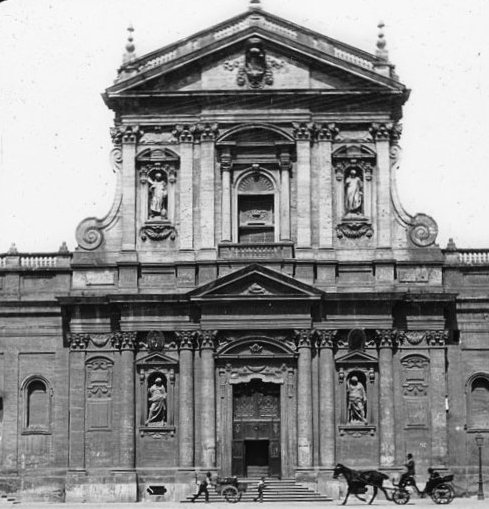
The land is an authentic early century Roman streetscape, centered around a church, with a park like area across the road, bordered by high ancient Roman stone walls. The road leading from the Hub to the Church and entrance to the attraction is basically all themed retail. There is a street style Pizzeria, a high class Italian restaurant, and two other attractions. One is a family friendly exploration zone through a church and its catacombs and caves, built under the park berm, and the other is a special effects and animatronics show in the local Museum, featuring Dr. Jones collection of mystical artifacts that somehow come to life. The main church and its obelisk are the focus and the center of the land. It has a Baroque facade, similar to Santa Susanna below, but much smaller, and a bit less ornate to fit in the theme park scale.
|
|
The entrance to the actual attraction is to the right, where there is a truck unloading pile of crates and barrels, all apparently Indy's equipment. There is also one of the amphibious vehicles on the back of a flatbed. The boxes hold the marquee for the attraction and form the start of the queues that then lead into the side door of the church. Follow along the queue on the plans below.
Inside the church, the queues turn right and proceed down the right aisle, past the empty church, and then through more doors and into the next room. The church interior is again similar to a Baroque church, like the interior of San Clemente, but again much smaller and less detailed, instead just giving the impression of an ornate church. The queue barely spends any time inside the space, because I think it works better for it to just be a quick image, and it felt more right to leave it as an open space. The queues then enter a kind of Church museum gallery, which is something I saw in multiple churches in Rome. The queues wind around display cases and paintings, all appearing to be very old and special. Then they pass down a gallery hall where there are large paintings about the history of Rome, setting up the story about the current church being built on top of an older church and Roman ruins below. The queues cross a hallway, with a window to the light on the left, and enter the small library research room. Book cases on every wall frame a large desk, where Doctor Jones has apparently been working. Books on the desk are open to historical maps and drawings of the cave system, and notes describe his plan of exploration. The table in the middle of the room holds a large paper map that he has drawn on, and sketches for the ride vehicle.
Back across the hallway, we exit the building to the ground level of the church cloister. The cloister is an enclosed courtyard with covered colonnades on all sides. We walk along the exterior of the grassy center courtyard, looking up at the empty second level balcony and the sky above before reentering the building, into Indy's work room. Boxes and crates are on our right and we begin to hear the audio narration that instructs us of our job here. In the next room, there are two blackboards, one with a chalk map and had written directions to us, the archaeological volunteers, and the other with a flickery black and white video reel, showing off the brand new vehicles that we will be riding, also doubling as the safety instructions. The projector is perilously stacked on barrels and boxes in the middle of the room and a gramophone sits on a footlocker to the side. We finally reach the point that we will descend, by stair or elevator. The queues lead down the staircase, turn, and then descend into the dark and damp ruins.
|
|
![]() |
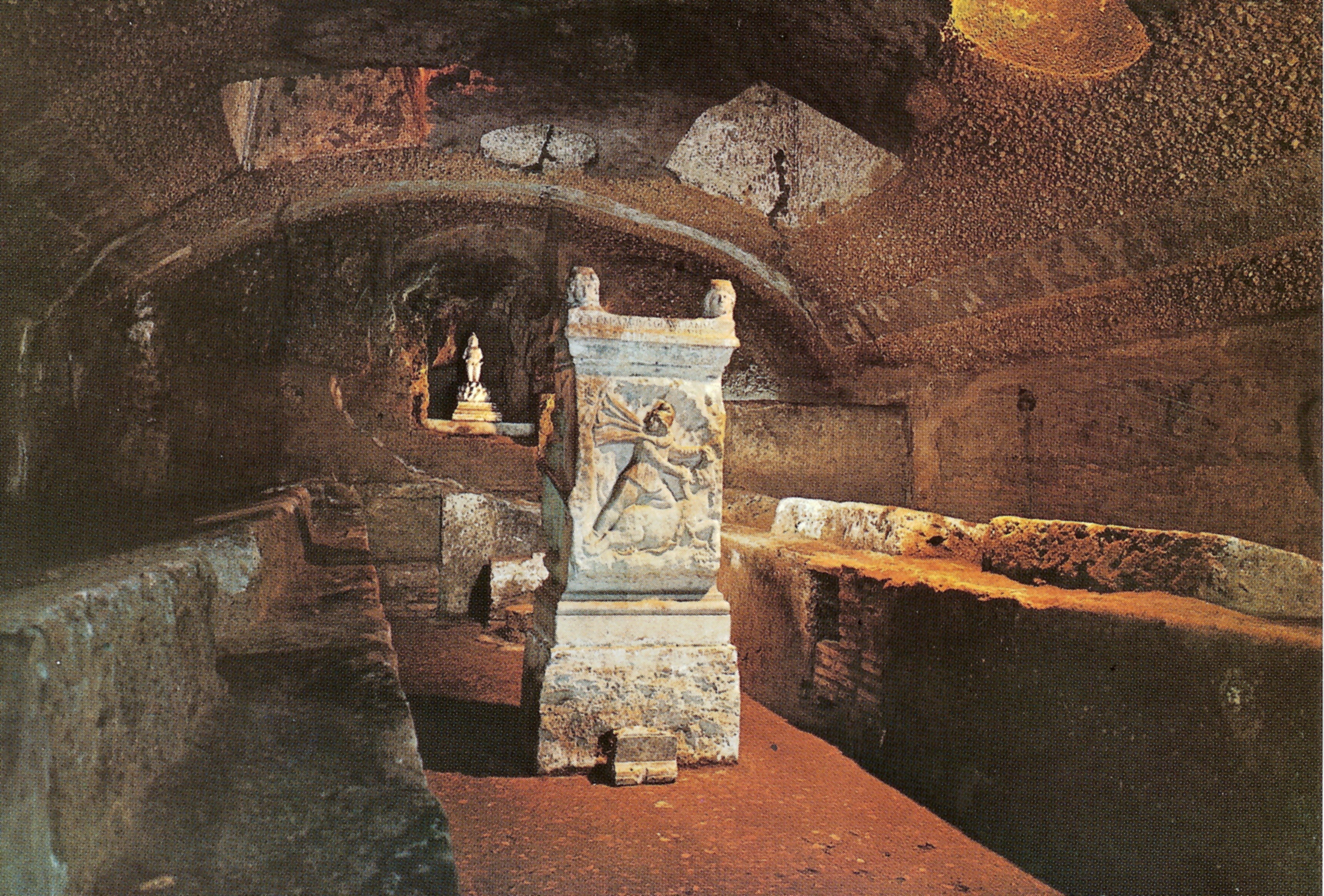
| Mithraeum Under San Clemente Basilica Allie Caulfield |
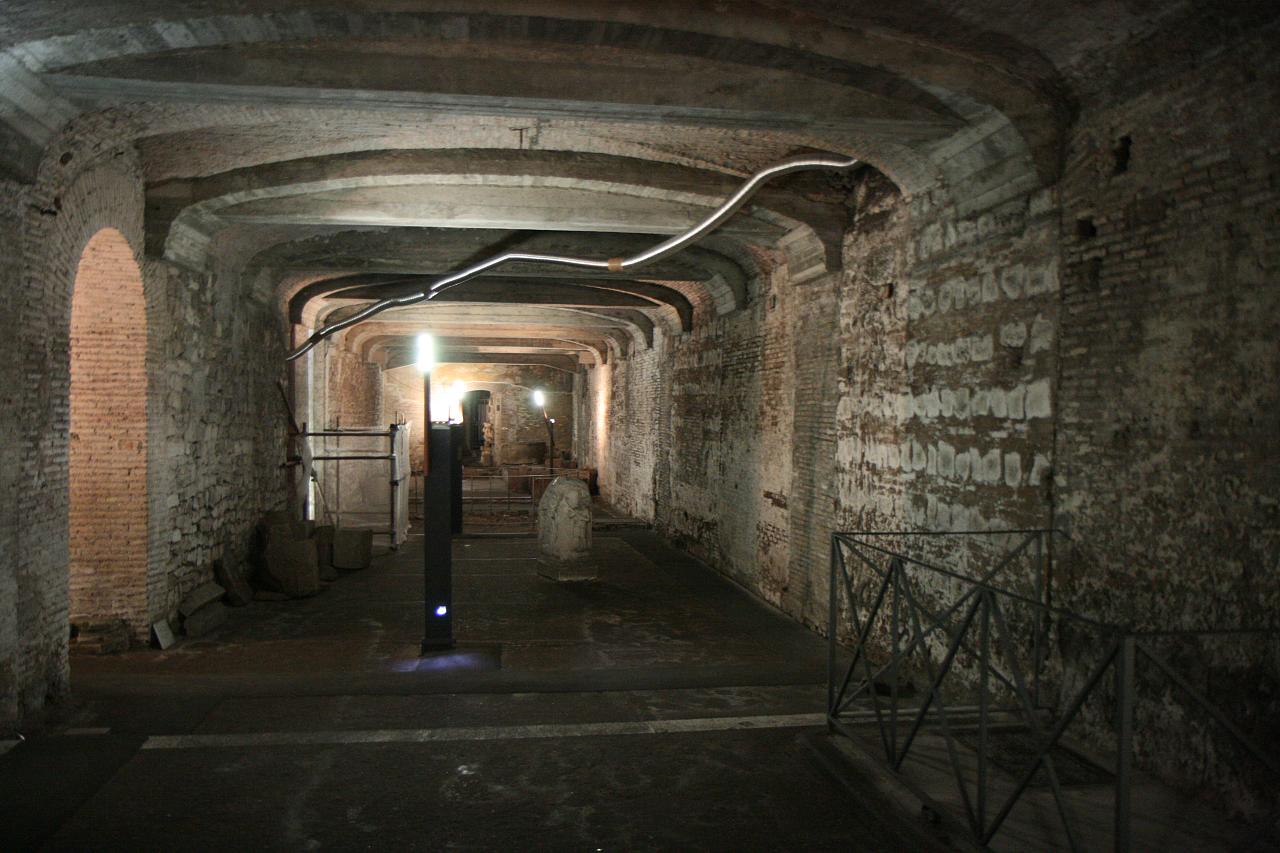
The queues turn left and weave between hefty rough stone pylons, what appear to be remnants of a structure from the past, some kind of chapel maybe. The rubble have begun to take over though, and through some gaps we can see the river beyond with ride vehicles swiftly passing. Imagine the setting like the picture above, but a little more disheveled and damp, like an active archaeological site. We pass through a lowered tunnel, and look down into an enclosed pit to our left where there is an ancient stone Roman altar in the process of being excavated, like the one above. The tunnel opens up into the main room of this lower queue, the historical church, where there are more thick stone supports holding up the shallowly arched roof. This is an impressive space. The queues weave between the pylons and piles of rubble and then reach the front of the room, where a cross vault spans over the river loading and unloading area. There are two loading docks to the left that load simultaneously and then both vehicles move up to two seat check stations. They then dispatch individually into a cave opening and the attraction beyond.
Back to the vehicle. It is a very detailed and complicated ride vehicle that seats 16 total. As for the look, it's easier to just let you look at the image collection below.
The main body is surrounded by a padded float and the tops of the non functional wheels just peek above the water line. The back holds a random assortment of boxes and supplies as well as extra tires. Each of the 4 rows has a storage bucket in front of them, which has a waterproof seal. The sections above show the mechanics of the system below the water.
The standard coaster track starts below water and a pretty standard chassis frame rides on that track. On this chassis is a 360 degree turntable which supports the lower half of the motion vehicle. This component is basically a basin with high walls on all sides, with all the mechanical equipment to create the motion sunk in the basin. The high side walls are able to slot into the vehicle above, so that the tops are actually above the water level, keeping the mechanical equipment out of the water. A bellow gasket along the high walls connects to the upper vehicle and helps to keep the water out of the lower vehicle basin. The upper vehicle, the show portion of the vehicle, then sits on top and overhangs the rest of the components below to hide them in the dark water. Guests actually ride above the water through the whole ride but the vehicle has enough bulk that this is not apparent.
Again, I am not an engineer, but I think this works and can provide a good amount of ride profile elements. It can pitch and roll from the upper motion components and the entire body can rotate 360 degrees as needed. Here's two video clips of this in action, animated and rendered in Blender.
This shows a rough approximation of the vehicle simulating swift rapids, the most active of the motions required in the attraction.
Back to the ride.
But ahead we can see a set of Doric columns, standing proud in the water, reaching the high rocky ceiling. We float towards them, and notice that a waterfall sits on either side of the path. We turn to see the full temple, a grid of the same columns and a stone altar facade on the left side. We have found it. But before we can do anything, a flame erupts from the torches at the altar and a spirit voice warns us that we have made it too close to the lost temple. To our right, the water quickly bubbles and a geyser shoots off, causing us to speed up as we get away. The water around us is getting violent and we are rocking a lot now, of course simulated by the vehicle. As we race out of there, the vehicle and track actually rise up just enough so that the vehicle is completely out of the water, so that it can create more drastic motions without the resistence of the water. We are swept away and pass a projection surface on our right that seamlessly joins the cave set, showing a huge flood swiftly approaching us.
We out of control float left and enter a projection tunnel setup. The vehicle moves along between the two surfaces, which show the catacombs beyond engulfed in fire and being destroyed by the quickly rising tides. The vehicle spins and rolls like it is caught in rapids, rotating a full 360 degrees out of control. Controlled water splashes and mist adds to the effect. Another smaller boat zooms by, with Indy on board, telling us that we really found some trouble, and that we need to escape to the lower catacombs with him. We bank around a left turn and plunge down a slope in darkness to the level below, splashing down in the base of the quiet river. We escaped, for now.
At the bottom of the falls, we see the boat Indy was on, crashed into the rocks. We turn the corner and leave the river, roughly driving up onto land. As soon as we are up, we get another radio message from Indy, saying he is clearing the path ahead, but watch out for traps that he missed. We begin slowly driving through the caves, over a lot of rough terrain simulated with the motion vehicle. Quickly, the first trap comes at us from the left, as a huge column topples directly in our ride path, forcing us to swerve out of the way just in time. A second comes from the right, forcing us to speed away around the corner, but we immediately face a huge swinging hammer in front of us, stopping us in our tracks and then stuttering as we time our race through the path. A second of the swings is permanently propped up on the side, suggesting Indy already encountered that one. To the right is a nook of skulls and bones around a pit of lava, with a small fireball erupting just as we pass. We swerve left into a narrow path, where we quickly feel darts shooting past us. Air jets simulate the feeling and prop effect darts pop out of the side walls. We make it through the tunnel and see Indy at the end, standing on a a few small crushed stone balls. We slow and pause as he congratulates us for making it through the traps, but complains that we had to cause so much trouble. He points us on, and we speed around the corner and enter the largest space of the attraction.
This double level space that we have opened into features a 180 degree hemispherical screen ahead of us, blending into real rockwork on the edges. In front of the screen is a set of tall Roman columns, matching the curve of the screen. Between the center columns is a ledge a section of real rockwork, holding a few pieces of glistening gold and glowing stones. We are driving on a rock "bridge" over water on either side, gently bubbling. As we enter and approach the center of the room, we see projected Indy climbing the rock wall between two of the columns, trying to get to the treasure at the center. As he approaches, the room suddenly is overtaken again by the protector spirit, causing the bubbling water to begin flaming, and a column of steam shoots up in front of center columns. An abstract face appears on the steam, warning us to abandon our search. Indy jumps away just before all the walls begin to crumble, and one of the columns actually starts to crumble and tilt towards us, threatening to crush us. Through this whole scene, we have been slowly moving along the curved track, but the vehicle has always pointed forwards, so we are now really facing backwards. Just as the rock walls begins to fall, we start to slip away backwards and then go down a small dip backwards into the darkness.
We then go through a small coaster portion of the adventure. Still backwards, we zoom around curves through the cave pillars. Then, while we go around a larger curve, we rotate back to forward and continue speeding along the only path we can see. Indy is yelling at us to follow the light, which we can see ahead to the right. But we slam to a stop in a dead end cave, with light flooding to us from above. We are seemingly stuck, but then we start to rumble and shake and then shoot straight up in a cloud of steam and mist as we ride the hidden geyser. We come to a stop at the top and slide out into one last river, but this river is much lighter and more peaceful. We turn the corner and we can immediately see well preserved Roman architecture and a pile of treasure and artifacts. Included are various international objects representing the reach of the Roman empire. As we turn the corner, the water starts to move more swiftly and we begin to float away faster. Suddenly we hear the rush of a waterfall and know what is about to happen. We are quickly drawn forward, turn a corner, and drop down a tall flume and splashdown in a catacomb lit by Indy's lanterns. We peacefully float around the corner through caves and find the final room, the ruins of the original church we found, where Indy stands surrounded by a limited selection of the treasure we found. He says something about managing to get some of the most important pieces out of the lost city and thanks us for out help.
We continue through a final cave opening, through a vehicle holding area, and back into the load/unload room we started in. We unload, walk up a stair case or use an elevator, and exit into a gift shop on the edge of the cloister we passed through earlier, completing the experience.
The only technical detail past the vehicles to point out is the vehicle maintenance bay on the lower level, just past load, which uses a sliding track switch to get vehicles there. It needs to be on the lower level because it should be adjacent to load and the control booths, but this is also a problem because this is the underground level of the attraction. The vehicles also need to be able to leave the building, so there is an included vehicle elevator adjacent to the maintenance bay. The maintenance bay track ends with a sliding platform that can be loaded onto the elevator and rolled out of the building to some kind of transport truck.
And that completes the design I have put together for this attraction!
Even though I designed this specifically for the Roman setting in my Disney Studios Paris plan, I've thought about how this could be cloned to a variety of settings pretty easily. For instance, if this were to be replicated for Hollywood Studios with a Mayan theme, it could use basically the same ride building with altered set dressings and a unique queue and load building. It could even be altered to have a different exterior flume drop because the drop is located at the front edge of the show building section of the attraction. Just cut what I have at the wall between the final drop and the first lift, turn the drop to be exterior, add on a separate queue and load building, and change the architecture of the temple scenes to Mayan ruins. Then it is a different experience and story. It reuses the technical system and layout, but is unique enough to be a different attraction.
So let me know what you think about this attraction concept! Also, let me know what you think about the new look. And make sure to follow on twitter to keep up with what's coming next.
Categories:
Attraction Concept
,
Design Post
,
Disney Studios Paris
,
Disneyland Paris Resort
Monday, November 28, 2016
Paris Studios Plan Epilogue
This is a quick follow up to the plan for my expansion of the Disney Studios Paris Park that was posted last week. Based on the response, I wanted to address a few things.
Next, I wanted to address a few comments I got.
The main comments were about the selection of properties for the Disney Studios area of the park. Since I left some expansion pads, I got a lot of suggestions for other choices. There were also a few thoughts about the choice to do the live action remakes vs the originals which I found interesting.
So there's a few reasons I chose the live action fairy tales.
I wanted some differentiation from the Disneyland Park, which is already heavy with classic animated films. And I definitely didn't want any repeats between the parks, so many of the popular and obvious films were out.
I wanted to use properties that could somehow still fit into a cohesive style and location idea, which became the "Fantasy Forest" kind of idea, versus disparate large themed areas that can't really transition.
I recognized that animated films could be grouped into a miniland based on the shared medium like they have done before with the Animation Courtyards.
And honestly, when you look at the filmography of the Walt Disney Pictures brand, leaving out Lucasfilm, Marvel, Pixar, and Walt Disney Animation Studios, the only films that have had significant success recently are the live action remakes. Consequently, those kinds of films make up the majority of the lineup for the next few years.
So that made my choice. However, even though I have reasons, I am not heavily committed to that selection because, for this land in particular, the contents are less important than the structure that holds the properties. I think the IPs could be subbed out pretty easily along the main spine path if a better argument can be made for other films and transitions somehow developed. Some interesting suggestions were Wreck it Ralph, Zootopia, and Moana, which would probably mean this transforms into an animated based land, since there I don't think I would want to mix animated and live action remakes.
The only other comments were about how people wish this would happen for real.
So from those comments, I want to discuss the potential of this park with a good deal more realism, especially in light of the huge expansion plan for Hong Kong Disneyland that was announced just the day after my post went up.
First, thanks for the great response and for sharing and commenting. The audience grew by a lot that day, which is great and hope you come back for future posts, even if they will not always be that big or about the Paris parks.
I've tried to have regular posting schedules from time to time but I never can stick to anything since it takes significant time commitment to design the project and then create the post. But my goal is to have at least one or two new posts up every month. Sometimes they are big park expansion plans, sometimes individual attractions, sometimes they are essays about theme park design, and sometimes they may just be random thoughts related to Disney and theme park news. So keep up with me on twitter and check back periodically for new stuff.
Next, I wanted to address a few comments I got.
The main comments were about the selection of properties for the Disney Studios area of the park. Since I left some expansion pads, I got a lot of suggestions for other choices. There were also a few thoughts about the choice to do the live action remakes vs the originals which I found interesting.
So there's a few reasons I chose the live action fairy tales.
I wanted some differentiation from the Disneyland Park, which is already heavy with classic animated films. And I definitely didn't want any repeats between the parks, so many of the popular and obvious films were out.
I wanted to use properties that could somehow still fit into a cohesive style and location idea, which became the "Fantasy Forest" kind of idea, versus disparate large themed areas that can't really transition.
I recognized that animated films could be grouped into a miniland based on the shared medium like they have done before with the Animation Courtyards.
And honestly, when you look at the filmography of the Walt Disney Pictures brand, leaving out Lucasfilm, Marvel, Pixar, and Walt Disney Animation Studios, the only films that have had significant success recently are the live action remakes. Consequently, those kinds of films make up the majority of the lineup for the next few years.
So that made my choice. However, even though I have reasons, I am not heavily committed to that selection because, for this land in particular, the contents are less important than the structure that holds the properties. I think the IPs could be subbed out pretty easily along the main spine path if a better argument can be made for other films and transitions somehow developed. Some interesting suggestions were Wreck it Ralph, Zootopia, and Moana, which would probably mean this transforms into an animated based land, since there I don't think I would want to mix animated and live action remakes.
The only other comments were about how people wish this would happen for real.
So from those comments, I want to discuss the potential of this park with a good deal more realism, especially in light of the huge expansion plan for Hong Kong Disneyland that was announced just the day after my post went up.
First, I think it is obvious that the plan I posted last week is way too elaborate to ever happen in its entirety at once. It would be an unprecedented expansion that would give the park more huge E ticket attractions that nearly all existing parks. And based on the spending habits of the resort, it is just impossible.
But I still think that this could be used as a guide to how the park should and really could grow in more reasonable expansion phases, similar to what is happening to other world wide parks. Hong Kong is a great example. It started as an under-built park, then a major expansion in 2009 brought 3 new lands with a few major attractions, then a few individual attractions over time, and now another major multi-land expansion. Yes its basically a 15 years time frame of improvement. But at least its happening.
And I think you can do the same to the Paris Studios Park. To start, I am going to talk general, not super specific to the actual attractions I proposed. More in terms of lands and general attraction ideas.
I think the key is to start with the infrastructure and organization that would then be expanded over a few big phases. This means the place making work at the front of the park, and I think the Hub and icon layout that defines the center of the park. Organization in a theme park will dictate the future success.
Also I think it is important to realize that in my plan, 3 of the 5 lands use a lot of existing infrastructure and also contain a solid number and variety of attractions. Hollywood, Pixar, and Marvel all are formed of careful additions into the existing landscape. Regardless of the specifics of the additions, the park could make some major improvements without having to completely tear down and start over. Start with what they already have.
And last, even though in my design, I basically went for all original designs, it should be understood that cloning attractions from other resorts makes them cheaper and therefore more likely to be built. That could help a lot here, since these are the kinds of attractions that Disney is currently already designing. This approach could bring some big attractions to the park.
So from that, I'll outline a quick idea for how to make something like this happen.
Major Phase 1:
Improve the place making of Hollywood - the interior of Stage 1 would be renovated in some way, the streets, planters, trolley tracks, and facades of Hollywood would be added, new retail and dining would open, and the Hub and Chinese Theater facade would be built, regardless of if there is an interior. This would also allow for the immediate start to a new night time show.
Add attractions to Toy Story Land - expand Toy Story Land to the north like I have with the addition of a clone of Toy Story Midway Mania and at least one more flat ride/spinner.
Renovate Pixar Place Overall - general work to the facades and planting to make it more cohesive, such as new Crush's Coaster facade and addition of meet and greet building.
Create Marvel Studios - renovate the existing buildings on the south side of the park into Stark Expo, including re-themes of Armageddon and Rockin Roller Coaster. Construct a clone of one of the Marvel attractions already in plans at another park. Either one of the HK attractions or the one in plans for DCA. Something that they can share development costs on that can be the headliner of the expansion. This attraction should also begin to define the expansion potential of the land deeper into the park.
That is all totally reasonable, adds or reworks 6 attractions, and begins to start a solid organization for the park. This could and should happen as soon as possible, especially since this whole phase doesn't even include any major brand new attractions, only clones. This would be a easy and effective start to fix the park.
Intermediate Additions
Add an attraction to Pixar Place - move the wardrobe and cast building and replace with a new D ticket level dark ride of a significantly popular Pixar story.
Put something in the Chinese Theater - put something significant in the icon, either an original attraction, an animation miniland like I have, or something like that Mickey Mouse dark ride. Something fitting the icon status.
Add an attraction to Marvel - either the secondary of the HK attractions, another clone from DCA, or something original. A second and final big attraction to expand the land and increase the park size.
Those are three solid additions that could sustain attendance to the park over multiple years, each phased to continue to draw crowds to come back for something new.
Major Phase 2:
Bring Star Wars - clone the entirety of original Star Wars land, which would now the the third and likely the easiest to build because there is no river or major demo to work around. (It would also make sense logically to do this earlier on, in phase 1 maybe, but I pushed it here so that I could have balanced phases and focus the first phase on rehabs to the existing park.)
Develop the start of the 5th and final land - whatever this would be, live action fairytales like I suggested, animated films, or something completely different, develop the first pocket or two of this land off the Hub and connect it to the other lands to create a full hub and spoke based loop. In my plan, that would be Beauty and the Beast and Little Mermaid, but could be whatever is popular at this point.
Those are two more huge but reasonable additions that would bring the park to a scale rivaling the other international parks and basically builds it out to a respectable scale.
Final Periodic Additions
Complete the 5th land - finish whatever land was started previously to bring it to the scale of the other lands.
Adjust for what becomes popular - if the 5th Indiana Jones movie becomes a hit, embrace that. Or expand more Star Wars, or Marvel, or live action, or anything else worth building.
These could be long range moves just to complete the organization and balance of the park while also allowing it to respond to trends.
That outline breaks down the overly ambitious plan that I presented into manageable, though significant, chunks of development that are not impossible. It could and should happen to make this the preeminent film park of Europe.
If you like what your reading, continue to like and share so that the audience can keep on growing, and if you have a suggestion or idea, leave me a comment here or on twitter.
Not sure what I'll have next for you, but look for something in mid December.
And I think you can do the same to the Paris Studios Park. To start, I am going to talk general, not super specific to the actual attractions I proposed. More in terms of lands and general attraction ideas.
I think the key is to start with the infrastructure and organization that would then be expanded over a few big phases. This means the place making work at the front of the park, and I think the Hub and icon layout that defines the center of the park. Organization in a theme park will dictate the future success.
Also I think it is important to realize that in my plan, 3 of the 5 lands use a lot of existing infrastructure and also contain a solid number and variety of attractions. Hollywood, Pixar, and Marvel all are formed of careful additions into the existing landscape. Regardless of the specifics of the additions, the park could make some major improvements without having to completely tear down and start over. Start with what they already have.
And last, even though in my design, I basically went for all original designs, it should be understood that cloning attractions from other resorts makes them cheaper and therefore more likely to be built. That could help a lot here, since these are the kinds of attractions that Disney is currently already designing. This approach could bring some big attractions to the park.
So from that, I'll outline a quick idea for how to make something like this happen.
Major Phase 1:
Improve the place making of Hollywood - the interior of Stage 1 would be renovated in some way, the streets, planters, trolley tracks, and facades of Hollywood would be added, new retail and dining would open, and the Hub and Chinese Theater facade would be built, regardless of if there is an interior. This would also allow for the immediate start to a new night time show.
Add attractions to Toy Story Land - expand Toy Story Land to the north like I have with the addition of a clone of Toy Story Midway Mania and at least one more flat ride/spinner.
Renovate Pixar Place Overall - general work to the facades and planting to make it more cohesive, such as new Crush's Coaster facade and addition of meet and greet building.
Create Marvel Studios - renovate the existing buildings on the south side of the park into Stark Expo, including re-themes of Armageddon and Rockin Roller Coaster. Construct a clone of one of the Marvel attractions already in plans at another park. Either one of the HK attractions or the one in plans for DCA. Something that they can share development costs on that can be the headliner of the expansion. This attraction should also begin to define the expansion potential of the land deeper into the park.
That is all totally reasonable, adds or reworks 6 attractions, and begins to start a solid organization for the park. This could and should happen as soon as possible, especially since this whole phase doesn't even include any major brand new attractions, only clones. This would be a easy and effective start to fix the park.
Intermediate Additions
Add an attraction to Pixar Place - move the wardrobe and cast building and replace with a new D ticket level dark ride of a significantly popular Pixar story.
Put something in the Chinese Theater - put something significant in the icon, either an original attraction, an animation miniland like I have, or something like that Mickey Mouse dark ride. Something fitting the icon status.
Add an attraction to Marvel - either the secondary of the HK attractions, another clone from DCA, or something original. A second and final big attraction to expand the land and increase the park size.
Those are three solid additions that could sustain attendance to the park over multiple years, each phased to continue to draw crowds to come back for something new.
Major Phase 2:
Bring Star Wars - clone the entirety of original Star Wars land, which would now the the third and likely the easiest to build because there is no river or major demo to work around. (It would also make sense logically to do this earlier on, in phase 1 maybe, but I pushed it here so that I could have balanced phases and focus the first phase on rehabs to the existing park.)
Develop the start of the 5th and final land - whatever this would be, live action fairytales like I suggested, animated films, or something completely different, develop the first pocket or two of this land off the Hub and connect it to the other lands to create a full hub and spoke based loop. In my plan, that would be Beauty and the Beast and Little Mermaid, but could be whatever is popular at this point.
Those are two more huge but reasonable additions that would bring the park to a scale rivaling the other international parks and basically builds it out to a respectable scale.
Final Periodic Additions
Complete the 5th land - finish whatever land was started previously to bring it to the scale of the other lands.
Adjust for what becomes popular - if the 5th Indiana Jones movie becomes a hit, embrace that. Or expand more Star Wars, or Marvel, or live action, or anything else worth building.
These could be long range moves just to complete the organization and balance of the park while also allowing it to respond to trends.
That outline breaks down the overly ambitious plan that I presented into manageable, though significant, chunks of development that are not impossible. It could and should happen to make this the preeminent film park of Europe.
If you like what your reading, continue to like and share so that the audience can keep on growing, and if you have a suggestion or idea, leave me a comment here or on twitter.
Not sure what I'll have next for you, but look for something in mid December.
Categories:
Discussion Post
,
Disney Studios Paris
,
Disneyland Paris Resort
,
Theme Park Concept
Monday, November 21, 2016
Disney's Hollywood Adventure Paris Park Plan
The Avengers, Iron Man, Spider-man, Indiana Jones, Star Wars, Robbin Hood, The Little Mermaid, The Jungle Book, Beauty and the Beast, Toy Story, Ratatouille, Inside Out, Finding Nemo, plus Disney Animation Studios, the Twilight Zone, and classic Hollywood cinema. That' s the outline of this new version of an expansion plan for the current Disney Studios Paris. It's a big lineup that makes this a true top tier movie park.
I posted a version of this plan a year and a half ago, a version that was admittedly under developed. I wanted to leave plenty of expansion area and I had already committed some big properties, including Star Wars, to the Disneyland Park, so the plan was light, and therefore, under received.
Since the result of that post, my plan was to come back with a larger and more ambitious design that includes the full spectrum of the film properties that are in the Disney company. That meant moving Star Wars and Indiana Jones to this park to consolidate the IP heavy hitters and save the Disneyland Park for more original areas. This is a firmly Hollywood IP style park, and should be, so I have no issue using almost completely IPs to create immersive worlds from the best films of the Disney family.
So I decided to structure the park around the big four film families of the company plus a entrance land based on classic Hollywood, all set around a modified hub and spoke that utilizes a good portion of the existing park layout and infrastructure.
Now for the details.
Old Hollywood is the substitute Main Street but is more substantial with multiple attractions. I kept the forecourt, water tower, and Stage 1, which I know many have suggested removing, but I believe it is an effective sequential entry path in this design, and personally think it is necessary to the park.
Stage 1 serves the same purpose as the Train Station by compressing the visual distance at the entrance of the park and creating a series of thresholds and steps to the ultimate experience of the inner park. The problem is that the existing park tries to make it the Train Station, Town Square, and Main Street all in one space, which does not work both because of crowding and density, and just because it does not make sense. If the interior space is not treated so heavily and instead can just be a transition space, really just a tunnel through to the other side, and not somewhere where guests are encouraged to linger, I think it can be a successful step into the real Main Street that I add ahead, and succeeds in blocking the view to the central park from the exterior park.
So the inside of Stage 1 is redressed as a classic golden age Hollywood set in the middle of filming, maybe a 1950's New York street, dressed for the big Singing in the Rain style musical number that is perpetually about to be filmed. The lights are on, the sound is rolling, and we have entered the idea of Hollywood. So now that we are not lingering in here to shop or eat, we move out of the building on the other side and find ourselves back in time in the streets of the ideal Hollywood. We pass under another studio arch, showing that we are now exiting the "studio" and entering the "real city". A roundabout, with Partners in the center, branches left, right, and straight ahead. Realistic city facades surround us, no fake studio style buildings visible except the one we just exited. Imagine the architecture style of Buena Vista Street for all this. The area that is currently just concrete wastelands is planned with streets and plenty of planted areas with trees.
Right is a short street that leads to Pixar Place, with a new large facade with retail on the existing theater and new facades on the current animation building. The Crush's Coaster building that terminates the street is rethemed as a classic aquarium, so the architecture blends into the Hollywood city style.
Straight ahead is the more normal Main Street section, but a little flipped. The current animation building with all new facades becomes exclusively retail as the main "Emporium" of the park. Beyond that on the right, replacing the Green Army Men Parachute ride, is The Brown Derby with outdoor seating looking to the Hub. The left side of the street has a new retail building in front of the Tower of Terror, and a small bakery building in the shadow of the tower. The Hub itself is similar to the traditional, and actually matches the dimensions of the Disneyland Park Paris Hub. The icon is the Chinese Theater, because what else says Hollywood. I mean, except the actual Hollywood letters, but making a hill an icon doesn't really work. I tried.
To the left is the most substantial area of this land with three attractions. Around another larger roundabout is more city facades, including the existing Cinemagic with a new facade and retail and the existing Tower of Terror which absolutely does not get rethemed. Even if the Twilight Zone theme leaves, it stays as a golden age Hollywood story. The new attraction replaces and reuses the Playhouse Disney building to create a modern attraction in the spirit of The Great Movie Ride, similar to what I proposed in my plan for California Adventure. The actual building is a movie theater, much smaller than the Chinese Theater, set for a Hollywood premier. Instead of just a tour through significant films, the attraction has the more interactive goal to put us in the movie making process as the stars of Hollywood instead of just being bystanders. This attraction is on a long term list of attractions to develop in the future. There is also a Red Car Trolley that runs through the land.
Pixar is the least affected of the lands but still gets changes. Like I mentioned, half of the existing Toy Story land is removed so that the Hub and the pathway into the Pixar area can be developed. The path leads to a central generic Pixar open area between the four film specific areas. Adjacent to this area is also a Pixar Cafe counter service location, with the same style as Pixar headquarters, and a meet and greet building and adjacent gazebo at the former animation building. Ratatouille is unchanged.
The Toy Story area extends north and includes three new attractions in the oversized toy world. There is a carousel where guests ride on a large toys, a balloon race style spinner, like Fliks Fliers, and a new big version of Toy Story Mania, set in an oversized board game box. The ride uses the same idea as the existing, but I would like to see a version that combines real sets and triggered effects and the digital game scenes, so that is what I propose here. Digital scenes are interspersed with larger than life toy sets that are filled with triggers and a few animatronic figures of the main characters.
I decided on Inside Out for the last expansion area, replacing the costuming building, and let this be a traditional dark ride through the world of the inner mind, using the train of thought as a ride vehicle.
The Finding Nemo area includes Crush's Coaster redressed and themed as an aquarium, with a larger interior aquarium lobby with limited example exhibits and a version of Turtle Talk.
Across the park, Marvel also reuses a few existing buildings. There are two areas in this land: Stark Expo, which uses Rockin Roller coaster, Armageddon, and the restaurant building, and New York, which is new construction. Thematically, these choices seemed obvious. Because of the extreme variety of characters and locations in the franchise, this needed to be a kind of median space where all the stories could come together, and that seems to often be New York. Coming from the left side of Hollywood, guests come down a promenade between modern and high tech facades on the existing buildings towards a large rotating video sphere at the end of the road, marking the Iron Man exhibit at the Expo. The existing restaurant building stays as a high tech counter service location, and the Armageddon building becomes a technology showcase area, with cool interactive technology games and exhibits about Iron Man and the Avengers. Rockin Roller Coaster is redressed as a Stark flying vehicle prototype attraction. The queue moves through preshows of Tony showing off his suit and the new vehicle we are getting to test and then we board for a flight around the Expo. This is done with both some physical sets that we fly by inside the dark building, and some projections along the side of the track, like in the Tron coaster and Hyperspace Mountain.
The New York area begins at the Hub and leads down a street, also towards the Stark Expo icon sphere. Limited retail on the left and right lead down to the intersection with the New York streets on the right. These are much larger facades to hide the large showbuildings. To the right is a Spider-man dark ride that uses a new or custom system to bring the swinging and height to the adventures of Spider-man. I am thinking something similar to the fabled Pandora's Box ride system that never really happened, where the ride vehicle is able to traverse through scenes both on the ground and up through the air. Spider-man deserves to be able to leave the ground. Across the street is the large Avengers attraction, which is some kind of motion based media attraction and would feature the entire Marvel roster, since this is the premier attraction of the land and the IP. Retail and a snack location or two fill in the facades.
The Lucas Studios land is two areas with two of the most popular stories of all cinema: Indiana Jones and Star Wars. The Star Wars area is a copy of what is coming to the American parks, and the drawing itself is based on my best interpretation of the art. I also included the possible future 3rd attraction, though I do not know what it is.
The Indiana Jones area is a little different that the other Indiana Jones theme park lands. Those are all jungle and temple themed, and those definitely work, but I wanted to try something a little more urban and play into another area that Indy has explored and add variety. I decided on creating a thrilling adventure through the underground catacombs of Rome, so the land is formed of an intersection of history-rich Roman streets and an open hilled park sitting along the crumbling Aurelian Walls, which is the border to Star Wars.
The land begins at the Hub and passes through a bit of a transition to move us from the Hub to Rome. The corridor between the Spider-man and Chinese Theater showbuildings is dressed as a backlot that gently fades into the real treatment of Rome, as if we are stepping onto a set and then into the film. Therefore, along this leg of the path, the facades are a little more fake and there is a Backlot Express counter service location. But turn the corner and it is full Rome, and once you are on this section of the street, the backlot theme is not visible at all.
The main attraction is on the right side, and begins in a historic church. The queue takes us through to the second level of the cloister, modeled on Bramante's Cloister in Rome and then down through the entrance to the ancient ruins below the church, where Indy is exploring for a lost ancient relic. The attraction is a new version of an EMV/water coaster hybrid that I am developing. Expect a post soon. The attraction floats us through a river of the catacombs where we encounter a lost Roman city in ruins, leading to dark ride and coaster portions of the attraction, before a final splashdown drop back into the catacombs river. This concept is based on some real Roman churches that I visited, specifically the Basilica of San Clemente al Laterano which is a 12th century church on top of a 4th century church on top of 1st century Roman ruins that includes a Roman cult temple. Literal layers of history the deeper you go, and somewhere that Indiana Jones would definitely explore.
Across the street is a pizzeria and retail, and the other side is an obelisk and the Roman Forum park, gently sloping up to the massive walls, blocking Star Wars. There is another smaller church building along the park, on the path leading to Star Wars. This is another entrance to the catacombs, but this is more of an exploration walk through attraction where you can explore a little area built under the sloping hill. The final building on the other side of the park holds a fine dining restaurant on the second floor, looking over the land, and an attraction on the ground floor set in an Antiquities museum. This is more of an animatronics and special effects show where we find some mysterious artifacts that Dr. Jones has recently found.
The last land is Walt Disney Studios and is the most diverse. I was a little unsure of how I wanted to go with this and what films to represent. I decided to do a single animation based area because so many of the animated films are already in the other park, and multiple individual areas based on the top live action films. The animation went in the Chinese Theater and attached interior space, which I think is a nice reminder of the central importance of the animated films to the success of the Disney company. Inside the interior land is a interior animated courtyard like the one in DCA, meet and greets, animation studios and interactive classes, and a new 360 degree version of Philharmagic, which uses the CircuMotion theater design.
For the other areas, I had to decide what films to represent. A look at the recent live action releases of the studio that are not Marvel or Lucas shows that the only thing that has shown real success is the live action classic animation films, so that was my direction. This was actually considered last time too, but it wasn't as definite that they were going to have success. I decided to set this up as basically a live action Fantasyland Forest, so the films needed to fit that feel. Also I wanted to do 3-4 lands now and leave room for 2-3 based on what finds success. So my picks: The Jungle Book because of its strong international success, Beauty and the Beast and the Little Mermaid because of their success potential based on how loved the classics are, and for the last slot, I'm making a prediction with Robbin Hood, which is supposed to be in the same vein as Pirates of the Caribbean. I think all of those have the potential to be popular and enough and an interesting enough themed environment to warrant space in the land.
The main entrance from the Hub moves along a long forested path, with the animation building on the left and Toy Story Land on the right. Once past Toy Story, we are in Belle's Village, with her cottage on the left and the village on the right. The cottage is a meet and greet, the village holds a large Gaston's Tavern and retail, and beyond is the Castle sitting on the rocky hill. Paths lead over a stream and through the woods towards the rock entrances to the undergrounds of the castle. Inside is a version of Be Our Guest but in a Ballroom that is even more regal based on the film design, and a large traditional dark ride through the story of the film.
Paths continue to the next area and transition to the jungles of the Jungle Book. This is much more densely vegetated to transport us deep in the jungle. The main attraction is a large classic boat ride through the world of the film, including sets and mixed media scenes. There is also a chain swing ride themed as swinging vines and a retail location inside a ruined temple.
Next, around the bend of the path, is The Little Mermaid area. We cross a bridge and look out over the new lagoon with Eric's castle on the other side. Ahead is a fishing village style area with a full size sailing ship that can be explored. Aside the castle is the entrance into the attraction, which is a "trackless" suspended dark ride like my proposal for UP that is also similar to the Tony Baxter Little Mermaid attraction concept. The ride exits to a large under the sea post show area. Inside the expansion on the showbuilding is Ariel's underwater kingdom with interactive play space, meet and greet, and retail.
Last is the Forest of Nottingham, where guests find a small town square in the woods with a castle looming above. In the town is a Nottingham Tavern that is seedy and mysterious. The castle is the entrance to the ride, which is some kind of large action filled media ride, with carriage ride vehicles that explore the exciting world of Robbin Hood. Back in the forest is a ropes course attraction high above the forest floor. Again, this area is based on a movie that is years away and I can only speculate that it will be successful because of its comparison to the Pirates franchise.
And this area loops back to the Indiana Jones Rome area, completing the park.
There is also a new parade route, which is noted with the red dash on the plan. It is approximately the same length as the castle park routes, matching the Magic Kingdom route closest. It stays in the front half of the park where there are the best defined paths instead of the back area which is too densely vegetated for a parade to really work.
There is also extra room in front of the Chinese Theater for roll out stages like Hollywood Studios has done before. I think this is a better option that a permanent stage.
And finally, for the nightly event, there is infrastructure includes for both projection and limited fireworks. Towers are included in the Hollywood architecture to project on the full Chinese Theater facade and the entire height of the Tower of Terror, creating more space for the show to be seen from. There is a main fireworks launch on the Indy building and smaller side launches behind and to the side as well as to the side of the Tower of Terror. The main launch could handle 3" shells with minimal closed fallout area, basically just part of Rome and the rest would just shoot low level pyro effects that don't require large fallout. If really needed, a large launch site could be located behind the park, past the public space, but night shows are getting lighter on fireworks, so I do not think it is necessary. Low level and projection effects should be enough.
This plan brings the park up to having 29 attractions vs the current 16 or so. Amazingly there are only 7 attractions that are not substantially changed, so it is an addition of 22 attractions. Only 4 see absolutely no change: Tower of Terror, Ratatouille, and the two remaining rides of Toy Story Land. This is alot of change for this park that makes it a real top level themed environment. I am much happier with this plan.
So what do you think about the plan? Did I include the films you wanted? Any suggestions for those last few expansions? Let me know!
I posted a version of this plan a year and a half ago, a version that was admittedly under developed. I wanted to leave plenty of expansion area and I had already committed some big properties, including Star Wars, to the Disneyland Park, so the plan was light, and therefore, under received.
Since the result of that post, my plan was to come back with a larger and more ambitious design that includes the full spectrum of the film properties that are in the Disney company. That meant moving Star Wars and Indiana Jones to this park to consolidate the IP heavy hitters and save the Disneyland Park for more original areas. This is a firmly Hollywood IP style park, and should be, so I have no issue using almost completely IPs to create immersive worlds from the best films of the Disney family.
So I decided to structure the park around the big four film families of the company plus a entrance land based on classic Hollywood, all set around a modified hub and spoke that utilizes a good portion of the existing park layout and infrastructure.
Now for the details.
Old Hollywood is the substitute Main Street but is more substantial with multiple attractions. I kept the forecourt, water tower, and Stage 1, which I know many have suggested removing, but I believe it is an effective sequential entry path in this design, and personally think it is necessary to the park.
Stage 1 serves the same purpose as the Train Station by compressing the visual distance at the entrance of the park and creating a series of thresholds and steps to the ultimate experience of the inner park. The problem is that the existing park tries to make it the Train Station, Town Square, and Main Street all in one space, which does not work both because of crowding and density, and just because it does not make sense. If the interior space is not treated so heavily and instead can just be a transition space, really just a tunnel through to the other side, and not somewhere where guests are encouraged to linger, I think it can be a successful step into the real Main Street that I add ahead, and succeeds in blocking the view to the central park from the exterior park.
So the inside of Stage 1 is redressed as a classic golden age Hollywood set in the middle of filming, maybe a 1950's New York street, dressed for the big Singing in the Rain style musical number that is perpetually about to be filmed. The lights are on, the sound is rolling, and we have entered the idea of Hollywood. So now that we are not lingering in here to shop or eat, we move out of the building on the other side and find ourselves back in time in the streets of the ideal Hollywood. We pass under another studio arch, showing that we are now exiting the "studio" and entering the "real city". A roundabout, with Partners in the center, branches left, right, and straight ahead. Realistic city facades surround us, no fake studio style buildings visible except the one we just exited. Imagine the architecture style of Buena Vista Street for all this. The area that is currently just concrete wastelands is planned with streets and plenty of planted areas with trees.
Right is a short street that leads to Pixar Place, with a new large facade with retail on the existing theater and new facades on the current animation building. The Crush's Coaster building that terminates the street is rethemed as a classic aquarium, so the architecture blends into the Hollywood city style.
Straight ahead is the more normal Main Street section, but a little flipped. The current animation building with all new facades becomes exclusively retail as the main "Emporium" of the park. Beyond that on the right, replacing the Green Army Men Parachute ride, is The Brown Derby with outdoor seating looking to the Hub. The left side of the street has a new retail building in front of the Tower of Terror, and a small bakery building in the shadow of the tower. The Hub itself is similar to the traditional, and actually matches the dimensions of the Disneyland Park Paris Hub. The icon is the Chinese Theater, because what else says Hollywood. I mean, except the actual Hollywood letters, but making a hill an icon doesn't really work. I tried.
To the left is the most substantial area of this land with three attractions. Around another larger roundabout is more city facades, including the existing Cinemagic with a new facade and retail and the existing Tower of Terror which absolutely does not get rethemed. Even if the Twilight Zone theme leaves, it stays as a golden age Hollywood story. The new attraction replaces and reuses the Playhouse Disney building to create a modern attraction in the spirit of The Great Movie Ride, similar to what I proposed in my plan for California Adventure. The actual building is a movie theater, much smaller than the Chinese Theater, set for a Hollywood premier. Instead of just a tour through significant films, the attraction has the more interactive goal to put us in the movie making process as the stars of Hollywood instead of just being bystanders. This attraction is on a long term list of attractions to develop in the future. There is also a Red Car Trolley that runs through the land.
Pixar is the least affected of the lands but still gets changes. Like I mentioned, half of the existing Toy Story land is removed so that the Hub and the pathway into the Pixar area can be developed. The path leads to a central generic Pixar open area between the four film specific areas. Adjacent to this area is also a Pixar Cafe counter service location, with the same style as Pixar headquarters, and a meet and greet building and adjacent gazebo at the former animation building. Ratatouille is unchanged.
The Toy Story area extends north and includes three new attractions in the oversized toy world. There is a carousel where guests ride on a large toys, a balloon race style spinner, like Fliks Fliers, and a new big version of Toy Story Mania, set in an oversized board game box. The ride uses the same idea as the existing, but I would like to see a version that combines real sets and triggered effects and the digital game scenes, so that is what I propose here. Digital scenes are interspersed with larger than life toy sets that are filled with triggers and a few animatronic figures of the main characters.
I decided on Inside Out for the last expansion area, replacing the costuming building, and let this be a traditional dark ride through the world of the inner mind, using the train of thought as a ride vehicle.
The Finding Nemo area includes Crush's Coaster redressed and themed as an aquarium, with a larger interior aquarium lobby with limited example exhibits and a version of Turtle Talk.
Across the park, Marvel also reuses a few existing buildings. There are two areas in this land: Stark Expo, which uses Rockin Roller coaster, Armageddon, and the restaurant building, and New York, which is new construction. Thematically, these choices seemed obvious. Because of the extreme variety of characters and locations in the franchise, this needed to be a kind of median space where all the stories could come together, and that seems to often be New York. Coming from the left side of Hollywood, guests come down a promenade between modern and high tech facades on the existing buildings towards a large rotating video sphere at the end of the road, marking the Iron Man exhibit at the Expo. The existing restaurant building stays as a high tech counter service location, and the Armageddon building becomes a technology showcase area, with cool interactive technology games and exhibits about Iron Man and the Avengers. Rockin Roller Coaster is redressed as a Stark flying vehicle prototype attraction. The queue moves through preshows of Tony showing off his suit and the new vehicle we are getting to test and then we board for a flight around the Expo. This is done with both some physical sets that we fly by inside the dark building, and some projections along the side of the track, like in the Tron coaster and Hyperspace Mountain.
The New York area begins at the Hub and leads down a street, also towards the Stark Expo icon sphere. Limited retail on the left and right lead down to the intersection with the New York streets on the right. These are much larger facades to hide the large showbuildings. To the right is a Spider-man dark ride that uses a new or custom system to bring the swinging and height to the adventures of Spider-man. I am thinking something similar to the fabled Pandora's Box ride system that never really happened, where the ride vehicle is able to traverse through scenes both on the ground and up through the air. Spider-man deserves to be able to leave the ground. Across the street is the large Avengers attraction, which is some kind of motion based media attraction and would feature the entire Marvel roster, since this is the premier attraction of the land and the IP. Retail and a snack location or two fill in the facades.
The Lucas Studios land is two areas with two of the most popular stories of all cinema: Indiana Jones and Star Wars. The Star Wars area is a copy of what is coming to the American parks, and the drawing itself is based on my best interpretation of the art. I also included the possible future 3rd attraction, though I do not know what it is.
The Indiana Jones area is a little different that the other Indiana Jones theme park lands. Those are all jungle and temple themed, and those definitely work, but I wanted to try something a little more urban and play into another area that Indy has explored and add variety. I decided on creating a thrilling adventure through the underground catacombs of Rome, so the land is formed of an intersection of history-rich Roman streets and an open hilled park sitting along the crumbling Aurelian Walls, which is the border to Star Wars.
The land begins at the Hub and passes through a bit of a transition to move us from the Hub to Rome. The corridor between the Spider-man and Chinese Theater showbuildings is dressed as a backlot that gently fades into the real treatment of Rome, as if we are stepping onto a set and then into the film. Therefore, along this leg of the path, the facades are a little more fake and there is a Backlot Express counter service location. But turn the corner and it is full Rome, and once you are on this section of the street, the backlot theme is not visible at all.
The main attraction is on the right side, and begins in a historic church. The queue takes us through to the second level of the cloister, modeled on Bramante's Cloister in Rome and then down through the entrance to the ancient ruins below the church, where Indy is exploring for a lost ancient relic. The attraction is a new version of an EMV/water coaster hybrid that I am developing. Expect a post soon. The attraction floats us through a river of the catacombs where we encounter a lost Roman city in ruins, leading to dark ride and coaster portions of the attraction, before a final splashdown drop back into the catacombs river. This concept is based on some real Roman churches that I visited, specifically the Basilica of San Clemente al Laterano which is a 12th century church on top of a 4th century church on top of 1st century Roman ruins that includes a Roman cult temple. Literal layers of history the deeper you go, and somewhere that Indiana Jones would definitely explore.
Across the street is a pizzeria and retail, and the other side is an obelisk and the Roman Forum park, gently sloping up to the massive walls, blocking Star Wars. There is another smaller church building along the park, on the path leading to Star Wars. This is another entrance to the catacombs, but this is more of an exploration walk through attraction where you can explore a little area built under the sloping hill. The final building on the other side of the park holds a fine dining restaurant on the second floor, looking over the land, and an attraction on the ground floor set in an Antiquities museum. This is more of an animatronics and special effects show where we find some mysterious artifacts that Dr. Jones has recently found.
The last land is Walt Disney Studios and is the most diverse. I was a little unsure of how I wanted to go with this and what films to represent. I decided to do a single animation based area because so many of the animated films are already in the other park, and multiple individual areas based on the top live action films. The animation went in the Chinese Theater and attached interior space, which I think is a nice reminder of the central importance of the animated films to the success of the Disney company. Inside the interior land is a interior animated courtyard like the one in DCA, meet and greets, animation studios and interactive classes, and a new 360 degree version of Philharmagic, which uses the CircuMotion theater design.
For the other areas, I had to decide what films to represent. A look at the recent live action releases of the studio that are not Marvel or Lucas shows that the only thing that has shown real success is the live action classic animation films, so that was my direction. This was actually considered last time too, but it wasn't as definite that they were going to have success. I decided to set this up as basically a live action Fantasyland Forest, so the films needed to fit that feel. Also I wanted to do 3-4 lands now and leave room for 2-3 based on what finds success. So my picks: The Jungle Book because of its strong international success, Beauty and the Beast and the Little Mermaid because of their success potential based on how loved the classics are, and for the last slot, I'm making a prediction with Robbin Hood, which is supposed to be in the same vein as Pirates of the Caribbean. I think all of those have the potential to be popular and enough and an interesting enough themed environment to warrant space in the land.
The main entrance from the Hub moves along a long forested path, with the animation building on the left and Toy Story Land on the right. Once past Toy Story, we are in Belle's Village, with her cottage on the left and the village on the right. The cottage is a meet and greet, the village holds a large Gaston's Tavern and retail, and beyond is the Castle sitting on the rocky hill. Paths lead over a stream and through the woods towards the rock entrances to the undergrounds of the castle. Inside is a version of Be Our Guest but in a Ballroom that is even more regal based on the film design, and a large traditional dark ride through the story of the film.
Paths continue to the next area and transition to the jungles of the Jungle Book. This is much more densely vegetated to transport us deep in the jungle. The main attraction is a large classic boat ride through the world of the film, including sets and mixed media scenes. There is also a chain swing ride themed as swinging vines and a retail location inside a ruined temple.
Next, around the bend of the path, is The Little Mermaid area. We cross a bridge and look out over the new lagoon with Eric's castle on the other side. Ahead is a fishing village style area with a full size sailing ship that can be explored. Aside the castle is the entrance into the attraction, which is a "trackless" suspended dark ride like my proposal for UP that is also similar to the Tony Baxter Little Mermaid attraction concept. The ride exits to a large under the sea post show area. Inside the expansion on the showbuilding is Ariel's underwater kingdom with interactive play space, meet and greet, and retail.
Last is the Forest of Nottingham, where guests find a small town square in the woods with a castle looming above. In the town is a Nottingham Tavern that is seedy and mysterious. The castle is the entrance to the ride, which is some kind of large action filled media ride, with carriage ride vehicles that explore the exciting world of Robbin Hood. Back in the forest is a ropes course attraction high above the forest floor. Again, this area is based on a movie that is years away and I can only speculate that it will be successful because of its comparison to the Pirates franchise.
And this area loops back to the Indiana Jones Rome area, completing the park.
There is also a new parade route, which is noted with the red dash on the plan. It is approximately the same length as the castle park routes, matching the Magic Kingdom route closest. It stays in the front half of the park where there are the best defined paths instead of the back area which is too densely vegetated for a parade to really work.
There is also extra room in front of the Chinese Theater for roll out stages like Hollywood Studios has done before. I think this is a better option that a permanent stage.
And finally, for the nightly event, there is infrastructure includes for both projection and limited fireworks. Towers are included in the Hollywood architecture to project on the full Chinese Theater facade and the entire height of the Tower of Terror, creating more space for the show to be seen from. There is a main fireworks launch on the Indy building and smaller side launches behind and to the side as well as to the side of the Tower of Terror. The main launch could handle 3" shells with minimal closed fallout area, basically just part of Rome and the rest would just shoot low level pyro effects that don't require large fallout. If really needed, a large launch site could be located behind the park, past the public space, but night shows are getting lighter on fireworks, so I do not think it is necessary. Low level and projection effects should be enough.
This plan brings the park up to having 29 attractions vs the current 16 or so. Amazingly there are only 7 attractions that are not substantially changed, so it is an addition of 22 attractions. Only 4 see absolutely no change: Tower of Terror, Ratatouille, and the two remaining rides of Toy Story Land. This is alot of change for this park that makes it a real top level themed environment. I am much happier with this plan.
So what do you think about the plan? Did I include the films you wanted? Any suggestions for those last few expansions? Let me know!
Categories:
Design Post
,
Disney Studios Paris
,
Disneyland Paris Resort
,
Theme Park Concept
Wednesday, March 9, 2016
Comparing Disney World, Disneyland, and Disneyland Paris
Having now visited three of the soon to be six castle parks of the world, I thought that it would be interesting to write a formal comparison of the parks, based on both general observations as well as more analysis of the urban plan strategy.
So to do this, I have decided on 10 qualities that I see as important. For each, I'll give some thoughts about how each park measures and decide on a winner.
Without getting into the analysis, my prediction is that the results will show that Disneyland is the most well rounded castle park, Magic Kingdom is the largest castle park, and Disneyland Paris is the best designed and most beautiful castle park. We will see if the below breakdown shows the same idea.
The Size and Scale of the Park
This category is to analyze not just the physical size of the park, but how well the park design responded to that size in the scale of its public spaces, buildings, and features.
Comparing the size of these three castle parks, they are actually not as drastically different as expected. Yes Disneyland is the smallest and most compact, but the Magic Kingdom and Disneyland Paris are just a little bit bigger, with Magic Kingdom as the largest based on my drawings. This honestly surprised me before I checked because Disneyland has a reputation for being so small. It appears however, that this misnomer comes from the extreme density Disneyland has because of it's
years of constant expansion versus the Magic Kingdoms relative slower pace of additions and Disneyland Paris's unfortunate lack of real expansions. This density has ramifications in many other categories below.
So with the actual physical size of the park not a huge differentiation between the three, we can turn to scale to set some comparisons.
Again, there is some reputation here. Disneyland has smaller buildings, which this time is a true fact. Both the Magic Kingdom and Paris have a larger scale, but it is much more noticeable in Orlando. I am specifically thinking about Main Street and the Castles of each park, because they are most directly comparable, but the lesson applied to the design of the whole park. All Main Streets technically feel realistically scaled by the evidence of their existence, but Disneyland most feels like real buildings in a real town, which helps with the immersive theme. Likewise with the castles, only one of them feels proper in scale to me. I grew up with Cinderella's Castle, so that was my ideal of a castle, but now after seeing the others it appears to be obviously over sized for the sake of being big, where as the others are more representative of reality. I see it as an issue with suspension of disbelief. Both Sleeping Beauty Castles are smaller, so to me, appear as if they could actually be real. But Cinderella's Castle is now so large and impressive that it reads as fake in comparison.
The scale of castles is also an issue because of their need to function both up close and far away, and again, this idea of scale having to work on multiple levels applies to the whole park. My specific thought is how each castle has to be iconic on the front facade yet not overpowering on the castle courtyard size. This is a challenge that only one succeeds at in my opinion. Cinderella's Castle succeeds at the front facade, but not the rear. Disneyland's is perfect as a castle courtyard facade, but is maybe a tad small on the front. But the castle of Paris had a bizarre and impressive effect to be iconically large to the front but much smaller to the rear. It works as the perfect scale in my opinion, so I see it as the most successful of the three.
These observations of scale apply to the philosophy of the whole park. Many elements of the Magic Kingdom feel larger in order to be larger, even if it doesn't help, such as the Rivers of America versus Disneyland's version. The positive of this is that the public spaces and walkway widths are much more reasonable for a functioning theme park, a major positive. However, Disneyland Paris also has these better planned public spaces without the oversized scale.
I think this category may end as a three way tie, for different positives of each park, but that is ok since this is a pretty big first category. Disneyland's size and scale may be smaller, but since it was first, uniformally feels the most natural. The Magic Kingdom is the largest, which means it has the largest and most impressive buildings and well structured crowd flow. Finally, Disneyland Paris has the best of both. Makes sense, as it was built from the knowledge of three previous parks and was able to improve, and possibly perfect, the size and scale issues of a castle park.
The Detail of the Park
Building on the idea of scale, this category looks at the level of detail found in the design of the park and is very dependent on the detail of the story lines and theme that define the areas of the parks.
All three parks are fairly successful here, but again Disneyland benefits from its density and origin and Paris benefits from its predecessors, while Magic Kingdom is just a bit behind, but improving. Detail is important because it creates the illusion of life, separating an obvious set from the illusion of the real world.
I see this as a question of the richness of decoration and depth of theme that creates the lands. It also happens to be a question of age, because many older areas of each park just do not have the same level of detail as a modern designed area. Less rigorous themeing was sufficient, such as original Fantasyland of Disneyland and Magic Kingdom.
Disneyland has been improved so as to move past many of these rudimentary areas, but unfortunately Magic Kingdom still has many, such as Fantasyland with the tents and parts of Tomorrowland that are basically just white buildings. Disneyland Paris benefited from not really ever having these issues of underdeveloped areas and was always designed with a higher level of realism.
A separate part of detail comes from the thoroughness of theme that creates a land. Main Streets have always been very detailed because they are recreating a once real world, based on a real place with real life. Other lands didn't originally have this detail because they were merely a generalized impression of an environment, such as the jungle or the old west. At Disneyland and Magic Kingdom, this was quickly changed as added details artificially created the world of the land. Disneyland Paris took this a step farther with highly detailed themes for the land, in some cases actual stories, that defined many of the design choices.
Maybe it is something that not everyone notices, but this attention to detail in worldbulding at Disneyland Paris really ties the park together into a series of cohesive and immersive environments. Therefore, I give the detail category to Paris, but Disneyland is close behind.
The Beauty of the Park
Similar to the detail of the park, the beauty of the park is closely tied to the visual design of the themed spaces.
This is an easy one. Of course all three are beautiful parks, as they are flagship Disney theme parks. I am considering more than just the baseline beauty and upkeep of a Disney quality theme park, but some kind of innate beauty in the total design. Disneyland has alot of special moments that are beautiful, as well as the Magic Kingdom in a few spaces, but the obvious winner is Disneyland Paris. This ties into the scale and the detail I just discussed.
It might also be the European audience of the park. Many times, I've heard commentary about how the park had to be extra beautiful to match with a continent of real castles and the worlds best architecture. It worked. This is a pretty personal opinion category, so you may disagree. And I could believe Disneyland as the answer here too I guess. Disneyland gets a lot of beauty from its age and nostalgia. The grown in vegetation, the compact architecture, the iconic sights, all come together for some special areas.
But as a picturesque park, Disneyland Paris is my personal favorite.
The Urban Planning
This category looks at a bigger picture idea of the urban plan for the park, specifically the arrangement and flow of public spaces.
This is the category that brings the original Disneyland down for me. Though it was a revolutionary design that created the modern theme park, it was an experiment and always has had crowd flow issues. Many pathways are just not wide enough and there still exists many pinch points that become miserable with even moderate crowd. The highlight of the urban plan however is the success of the visual icons and hub and spoke system, which carried over to the other parks. That system creates some special moments of visual structure that are not found in other parks. I also have to admit that the smaller scale of paths is also a positive, because it feels more realistic and less formally planned.
Alternately, the Magic Kingdom was designed to be big enough for real crowds, so the paths are much better spaced out while still having the benefits of the visual structure. The problem is the super wide stretches of concrete, specifically the path of Frontierland, which is extra wide for the parade. It just does not seem realistic or in theme. As an urban planning analysis though, it is not that big of a problem.
Similarly, Disneyland Paris has proper spacing and sizing for crowds, and actually is quite generous because the crowd level is unfortunately the lightest. There might also be less awkward, obvious planned moments here, likely because of the use of much more organic vegetation and water elements, like Fantasyland, which does not have large open stretches of concrete.
Here, Magic Kingdom and Disneyland Paris tie just because they were planned large enough so that they can be enjoyed in a crowd.
The Overall Attractions
The next few describe the attractions of the parks, and this on in particular looks at them as an overall park wide collection of experiences.
As a general statement about the amount of attractions of each park, I would have to say that Disneyland is exceptional, Magic Kingdom is sufficient, and Paris is relatively lacking. That's unsurprising, based on a lot of the factors I have already talked about.
I don't want to only mention quantity, but quality is a more subjective idea.
Each of the three parks have a solid set of headliners and a collection of great supporting attractions. All three have many of the iconic attractions that define the idea of a Disney parks, though Paris lacks a few of them, such as the Jungle Cruise. The lack of the iconic headliners was disappointing, but the total reworking of the park makes it understandable, and other attractions step up to be highlights.
In the specific case of a few attractions at Paris, there are a few attractions that are total re imaginings of the original, which is really appealing for someone traveling to all three. Without yet making a quality judgement of the changes, just the fact that it is different, not just a copy, is a big positive. Luckily, a few of those re worked attractions are actually better than the rest, like Big Thunder and Space Mountain, which are among the best of the type.
The attractions of Disneyland are the best maintained and are generally the most frequently updated, which is very valuable. The Magic Kingdom attractions are known to have more issues and additions are rare events, just like at Paris. Thats a major plus for Disneyland. But again that is a necessity for the type of audience at Disneyland.
I also wanted to consider variety. Variety automatically comes with quantity, so this may end up going for Disneyland. All three parks have the basic requirements of family friendly dark rides, flat rides, higher thrill rides, and media based rides.
In my view, Disneyland has more simple dark rides and classic family friendly attractions, Magic Kingdom has an even balance between types, and Paris has more thrill attractions.
If I try to think about the total impression of the attractions, I try to separate the numbers, but I think it automatically biases me to saying Disneyland has the most successful roster of overall attractions, even if the other two parks are plenty good for different reasons.
The Unique Attractions
This category specifically looks at the attractions that make each park unique because of their weird, unexpected, or cool design.
This category was honestly included so as to give credit to the weird little experiences that don't get much credit but I see as special to the total experience of the park. There are a few big examples of this in each park. At Disneyland, the variety of transportation attractions and the few originals from opening day. At Magic Kingdom, some old school attractions only found here. And at Disneyland Paris, the selection of fantastic environmental walkthrough attractions.
Disneyland's unique attractions are some of the unheralded opening day or early park attractions that are purely transportation systems. Walt's original park was a collection of transportation systems shaped into theme park attractions. The steam trains, the Mark Twain and the Columbia, the Autopia, the Horse-drawn Carriages and Main Street Vehicles, the canoes. All are attractions that are not big name draws but add alot to the park, specifically kinetic motion and activity. Of course some of those were copied to the other two parks, but they are unique here because they are the original, before they were seen as part of the expected castle park roster and became theme park attractions. At Disneyland, they were real life transportation.
The Magic Kingdom honestly does not have that many unique attractions. But what it does have is a few older attractions that no other park has: the Peoplemover, The Country Bears, and The Carousel of Progress. I would say these are cult attractions whose fan bases really appreciate their history and their unique place in the development of theme parks. Many other unique attractions have been forced out for cuts or for things anticipated to be more popular, such as Alien Encounter or the Timekeeper, which are among the most in-theme of all past and present Tomorrowland attractions. The other parks of course have cult attractions but not like these.
At Disneyland Paris, there actually are a good number of attractions that no other park has and they are even more unique because they are walk throughs, which most other parks have abandoned. The Dragon's Crypt and the Nautilus are the best examples, because they have the production quality and story of full fledged attractions, but are reshaped into totally immersive environments. Walkthroughs are often impractical, but it creates a more effective experience, I think because we no longer have to suspend disbelief due to a ride system or a queue. It is a real world that we are able to stand in and explore in all reality. There is a more authentic connection, and makes these unique attractions really special.
I believe that this is the attractions category where Paris finally wins. I just love those walkthroughs too much.
The Lands of the Park
The next two categories get more specific into the best individual elements of each park. This category compares what I think is the best example of each land type.
At Disneyland, as I mentioned, I think is the best example of the Main Street type, likely because of its history and scale. This is the land that most feels like walking right through a real small town in turn of the century America. Both lands in the Magic Kingdom and Disneyland Paris at times feel like reconstructions of the original, which is exactly what they are. That doesn't mean they are bad, but Disneyland is the prime example.
The Magic Kingdom has what I think is the best Adventureland. To really show the mystery of the jungle, the land needs to be constricting, but endless, as if it just keeps on going. The land is the Magic Kingdom does this far better than the too small Adventureland in Disneyland or the very large and open Adventureland of Paris. I like the winding path through the multiple sub areas at the Magic Kingdom.
Disneyland Paris has the best Frontierland, because of its size and detailed theme. It feels like a complete world, compared to the other two which are either very small at Disneyland, or a little misguided at Magic Kingdom. The detailed storyline that ties into every attraction, store, and restaurant is unique among castle park lands, and it really works well here.
Equating Liberty Square and New Orleans Square, the Disneyland version is likely better due to its size, history, and attractions. Liberty Square is an under appreciated land, but does not compare to the original example of highly immersive land building.
Fantasyland is a difficult decision between Disneyland and Disneyland Paris. Disneyland Paris is far more beautiful, has strong attractions, and is the ideal vision of fantasy, but Disneyland has an innate history that give its strength. Both far surpass Magic Kingdom, though the recent expansion helps. The rest of the areas of this land though read as old and under developed, such as the remaining tent facades and the lack of a Small World facade. I think I may give it to Disneyland for history, but both are valid decisions in my view.
Finally, the Tomorrowland/Discoveryland combination. If all are seen as equal, Discoveryland is the far superior version because of the unified (mostly) theme and the strong consistent design. However, I think thats not fair to the other two since the lands have different thematic goals. Therefore, I have to see the Magic Kingdom as the best Tomorrowland, and that is again because of the attempted visual consistency versus Disneyland which is a little bit of a mess. Plus it still has the Peoplemover, so easy decision.
Based on those decisions, it appears as if the best of the best are actually distributed pretty well, which is not surprising as these are three high quality parks.
The Attractions of the Park
Similarly, this category compares some of the best attractions in each park.
To be fair, I am going to cover the attractions that are both consistent to all three yet not exact copies from park to park. I decided on a group of four big ones: Space Mountain, Haunted Mansion, Pirates of the Caribbean, and Small World.
Space Mountain is drastically different at the three, specifically in level of intensity which makes a big difference. My decision is split. I think that Paris is the best themed while Disneyland is the best coaster. The Discoveryland visual style and the exterior launch are very cool elements of the Paris attraction which make it a real iconic element. The design at Disneyland is not as unique, but the coaster is smoother and more fun, which is important. Space Mountain at Magic Kingdom is far behind the others, but still fun. Space Mountain is an important comparative attraction because it is really the quintessential Disney coaster. It's nature of being enclose and in the dark gives it some legend. I think the quality of the three reflect their audience as well. Magic Kingdom is the tamest because it has the status of many's first real coaster at a more family friendly park. At Disneyland, the local dynamic requires it to be a bit more developed. And at Paris, Europeans are used to more thrills from their rides.
The Haunted Mansion is much more similar, using the same track and many similar elements across the three. Here, it is pretty uniformly agreed that Magic Kingdom has the best Mansion, though Phantom Manor is quite unique and the Hatbox Ghost is very cool. The Mansion at the Magic Kingdom just feels the best maintained and the most clear of the original intent, a surreal environmental trip through the world of ghosts. I also only was able to see the Disneyland version with its overlay, which I expected to enjoy but actually didn't that much. It just feels like the original attractions is at such a high level that it doesn't need to be reworked or overlayed. Original is best.
Pirates of the Caribbean is the same way. The original at Disneyland is mostly the best, because it was the original vision, is the longest, and is in the best land for it. The Magic Kingdom version is an obvious cut down, but is still good enough. The Paris version however tried something different, which I give it credit for. The restructured ride flow kept my attention and put me more into the action of the ride. Plus it is the last without Jack, for now at least. I think there are a good deal of attractions with this same case. The original at Disneyland set the quality bar. The Magic Kingdom version either cut it down or failed to improve on it. And then the Paris version tried something different.
Last, Small World is obviously lacking at one location. The lack of facade at Magic Kingdom is incredibly disappointing after seeing the versions at the other two parks. The attractions inside are basically the same, so no need to comment there. The Paris version also seemed to be better integrated into Fantasyland versus Disneyland where is almost has its own unique area.
So like the last category, I think this shows that there is actually a good distribution of quality through the parks, even if some other factors relating to attractions are not even.
The Night-time Entertainment and Environment
Finally, this category looks at the character of the park at night including the night time entertainment of each park.
This is my excuse to comment on how far behind the Magic Kingdom is with its night events. In my opinion, Disneyland has the best parade, Paint the Night, and Paris has the best fireworks, Disney Dreams. Both Magic Kingdom attempts are out of date and disappointing by comparison. Disneyland gets extra points because it also has Fantasmic and great fireworks. I see these nighttime events as being very important to the overall experience of the day because it is the grand finale.
As for the nighttime character of the parks, both Disneyland and the Magic Kingdom do well at this because they have long hours and plenty of attractions to keep the park active. With my experience of Disneyland Paris, most of the park began to close and was emptied with the darkness, leading guests to wait for Dreams. That was a shame because I the special detail of the park extended to the lighting, and I had hoped to be able to see how the park responded to the darkness. I was only able to see Discoveryland and Main Street in lights, which were really well done areas.
My favorite area of the other two parks at night is Adventureland, because the low level lighting in the jungle sets a intense mood of adventure.
Conclusion - An Overall Opinion of the Parks
To sum the above comparisons is difficult. All three parks have their own value and I really enjoy them all. Additionally, my bias may affect my views, because Magic Kingdom is the standard to me while Disneyland and Paris are the cool new parks to me.
For the design and beauty of the park categories, I believe it is tied between Disneyland Paris and Disneyland, because of both their actual design and the history.
For the attraction categories, I think it is obvious that Disneyland is the best because of both quantity and quality.
But for the best of categories, my analysis shows that the quality is spread well through the three parks.
What this means to me is that all three have the potential to be great and to improve.
Disneyland's lacking is the urban plan and the issues caused by its density and age.
Magic Kingdom is lacking in some detail and beauty, but it is being improved as attractions and lands are added.
And Paris can built upon its excellent design and beauty by adding more attractions that fill in the variety of experiences that make a great park.
So now, what do you think about the comparison between the three parks? If you are familiar with the three, I would love to hear your views about qualities I set up above.
So to do this, I have decided on 10 qualities that I see as important. For each, I'll give some thoughts about how each park measures and decide on a winner.
Without getting into the analysis, my prediction is that the results will show that Disneyland is the most well rounded castle park, Magic Kingdom is the largest castle park, and Disneyland Paris is the best designed and most beautiful castle park. We will see if the below breakdown shows the same idea.
The Size and Scale of the Park
This category is to analyze not just the physical size of the park, but how well the park design responded to that size in the scale of its public spaces, buildings, and features.
Comparing the size of these three castle parks, they are actually not as drastically different as expected. Yes Disneyland is the smallest and most compact, but the Magic Kingdom and Disneyland Paris are just a little bit bigger, with Magic Kingdom as the largest based on my drawings. This honestly surprised me before I checked because Disneyland has a reputation for being so small. It appears however, that this misnomer comes from the extreme density Disneyland has because of it's
years of constant expansion versus the Magic Kingdoms relative slower pace of additions and Disneyland Paris's unfortunate lack of real expansions. This density has ramifications in many other categories below.
So with the actual physical size of the park not a huge differentiation between the three, we can turn to scale to set some comparisons.
Again, there is some reputation here. Disneyland has smaller buildings, which this time is a true fact. Both the Magic Kingdom and Paris have a larger scale, but it is much more noticeable in Orlando. I am specifically thinking about Main Street and the Castles of each park, because they are most directly comparable, but the lesson applied to the design of the whole park. All Main Streets technically feel realistically scaled by the evidence of their existence, but Disneyland most feels like real buildings in a real town, which helps with the immersive theme. Likewise with the castles, only one of them feels proper in scale to me. I grew up with Cinderella's Castle, so that was my ideal of a castle, but now after seeing the others it appears to be obviously over sized for the sake of being big, where as the others are more representative of reality. I see it as an issue with suspension of disbelief. Both Sleeping Beauty Castles are smaller, so to me, appear as if they could actually be real. But Cinderella's Castle is now so large and impressive that it reads as fake in comparison.
The scale of castles is also an issue because of their need to function both up close and far away, and again, this idea of scale having to work on multiple levels applies to the whole park. My specific thought is how each castle has to be iconic on the front facade yet not overpowering on the castle courtyard size. This is a challenge that only one succeeds at in my opinion. Cinderella's Castle succeeds at the front facade, but not the rear. Disneyland's is perfect as a castle courtyard facade, but is maybe a tad small on the front. But the castle of Paris had a bizarre and impressive effect to be iconically large to the front but much smaller to the rear. It works as the perfect scale in my opinion, so I see it as the most successful of the three.
These observations of scale apply to the philosophy of the whole park. Many elements of the Magic Kingdom feel larger in order to be larger, even if it doesn't help, such as the Rivers of America versus Disneyland's version. The positive of this is that the public spaces and walkway widths are much more reasonable for a functioning theme park, a major positive. However, Disneyland Paris also has these better planned public spaces without the oversized scale.
I think this category may end as a three way tie, for different positives of each park, but that is ok since this is a pretty big first category. Disneyland's size and scale may be smaller, but since it was first, uniformally feels the most natural. The Magic Kingdom is the largest, which means it has the largest and most impressive buildings and well structured crowd flow. Finally, Disneyland Paris has the best of both. Makes sense, as it was built from the knowledge of three previous parks and was able to improve, and possibly perfect, the size and scale issues of a castle park.
The Detail of the Park
Building on the idea of scale, this category looks at the level of detail found in the design of the park and is very dependent on the detail of the story lines and theme that define the areas of the parks.
All three parks are fairly successful here, but again Disneyland benefits from its density and origin and Paris benefits from its predecessors, while Magic Kingdom is just a bit behind, but improving. Detail is important because it creates the illusion of life, separating an obvious set from the illusion of the real world.
I see this as a question of the richness of decoration and depth of theme that creates the lands. It also happens to be a question of age, because many older areas of each park just do not have the same level of detail as a modern designed area. Less rigorous themeing was sufficient, such as original Fantasyland of Disneyland and Magic Kingdom.
Disneyland has been improved so as to move past many of these rudimentary areas, but unfortunately Magic Kingdom still has many, such as Fantasyland with the tents and parts of Tomorrowland that are basically just white buildings. Disneyland Paris benefited from not really ever having these issues of underdeveloped areas and was always designed with a higher level of realism.
A separate part of detail comes from the thoroughness of theme that creates a land. Main Streets have always been very detailed because they are recreating a once real world, based on a real place with real life. Other lands didn't originally have this detail because they were merely a generalized impression of an environment, such as the jungle or the old west. At Disneyland and Magic Kingdom, this was quickly changed as added details artificially created the world of the land. Disneyland Paris took this a step farther with highly detailed themes for the land, in some cases actual stories, that defined many of the design choices.
Maybe it is something that not everyone notices, but this attention to detail in worldbulding at Disneyland Paris really ties the park together into a series of cohesive and immersive environments. Therefore, I give the detail category to Paris, but Disneyland is close behind.
The Beauty of the Park
Similar to the detail of the park, the beauty of the park is closely tied to the visual design of the themed spaces.
This is an easy one. Of course all three are beautiful parks, as they are flagship Disney theme parks. I am considering more than just the baseline beauty and upkeep of a Disney quality theme park, but some kind of innate beauty in the total design. Disneyland has alot of special moments that are beautiful, as well as the Magic Kingdom in a few spaces, but the obvious winner is Disneyland Paris. This ties into the scale and the detail I just discussed.
It might also be the European audience of the park. Many times, I've heard commentary about how the park had to be extra beautiful to match with a continent of real castles and the worlds best architecture. It worked. This is a pretty personal opinion category, so you may disagree. And I could believe Disneyland as the answer here too I guess. Disneyland gets a lot of beauty from its age and nostalgia. The grown in vegetation, the compact architecture, the iconic sights, all come together for some special areas.
But as a picturesque park, Disneyland Paris is my personal favorite.
The Urban Planning
This category looks at a bigger picture idea of the urban plan for the park, specifically the arrangement and flow of public spaces.
This is the category that brings the original Disneyland down for me. Though it was a revolutionary design that created the modern theme park, it was an experiment and always has had crowd flow issues. Many pathways are just not wide enough and there still exists many pinch points that become miserable with even moderate crowd. The highlight of the urban plan however is the success of the visual icons and hub and spoke system, which carried over to the other parks. That system creates some special moments of visual structure that are not found in other parks. I also have to admit that the smaller scale of paths is also a positive, because it feels more realistic and less formally planned.
Alternately, the Magic Kingdom was designed to be big enough for real crowds, so the paths are much better spaced out while still having the benefits of the visual structure. The problem is the super wide stretches of concrete, specifically the path of Frontierland, which is extra wide for the parade. It just does not seem realistic or in theme. As an urban planning analysis though, it is not that big of a problem.
Similarly, Disneyland Paris has proper spacing and sizing for crowds, and actually is quite generous because the crowd level is unfortunately the lightest. There might also be less awkward, obvious planned moments here, likely because of the use of much more organic vegetation and water elements, like Fantasyland, which does not have large open stretches of concrete.
Here, Magic Kingdom and Disneyland Paris tie just because they were planned large enough so that they can be enjoyed in a crowd.
The Overall Attractions
The next few describe the attractions of the parks, and this on in particular looks at them as an overall park wide collection of experiences.
As a general statement about the amount of attractions of each park, I would have to say that Disneyland is exceptional, Magic Kingdom is sufficient, and Paris is relatively lacking. That's unsurprising, based on a lot of the factors I have already talked about.
I don't want to only mention quantity, but quality is a more subjective idea.
Each of the three parks have a solid set of headliners and a collection of great supporting attractions. All three have many of the iconic attractions that define the idea of a Disney parks, though Paris lacks a few of them, such as the Jungle Cruise. The lack of the iconic headliners was disappointing, but the total reworking of the park makes it understandable, and other attractions step up to be highlights.
In the specific case of a few attractions at Paris, there are a few attractions that are total re imaginings of the original, which is really appealing for someone traveling to all three. Without yet making a quality judgement of the changes, just the fact that it is different, not just a copy, is a big positive. Luckily, a few of those re worked attractions are actually better than the rest, like Big Thunder and Space Mountain, which are among the best of the type.
The attractions of Disneyland are the best maintained and are generally the most frequently updated, which is very valuable. The Magic Kingdom attractions are known to have more issues and additions are rare events, just like at Paris. Thats a major plus for Disneyland. But again that is a necessity for the type of audience at Disneyland.
I also wanted to consider variety. Variety automatically comes with quantity, so this may end up going for Disneyland. All three parks have the basic requirements of family friendly dark rides, flat rides, higher thrill rides, and media based rides.
In my view, Disneyland has more simple dark rides and classic family friendly attractions, Magic Kingdom has an even balance between types, and Paris has more thrill attractions.
If I try to think about the total impression of the attractions, I try to separate the numbers, but I think it automatically biases me to saying Disneyland has the most successful roster of overall attractions, even if the other two parks are plenty good for different reasons.
The Unique Attractions
This category specifically looks at the attractions that make each park unique because of their weird, unexpected, or cool design.
This category was honestly included so as to give credit to the weird little experiences that don't get much credit but I see as special to the total experience of the park. There are a few big examples of this in each park. At Disneyland, the variety of transportation attractions and the few originals from opening day. At Magic Kingdom, some old school attractions only found here. And at Disneyland Paris, the selection of fantastic environmental walkthrough attractions.
Disneyland's unique attractions are some of the unheralded opening day or early park attractions that are purely transportation systems. Walt's original park was a collection of transportation systems shaped into theme park attractions. The steam trains, the Mark Twain and the Columbia, the Autopia, the Horse-drawn Carriages and Main Street Vehicles, the canoes. All are attractions that are not big name draws but add alot to the park, specifically kinetic motion and activity. Of course some of those were copied to the other two parks, but they are unique here because they are the original, before they were seen as part of the expected castle park roster and became theme park attractions. At Disneyland, they were real life transportation.
The Magic Kingdom honestly does not have that many unique attractions. But what it does have is a few older attractions that no other park has: the Peoplemover, The Country Bears, and The Carousel of Progress. I would say these are cult attractions whose fan bases really appreciate their history and their unique place in the development of theme parks. Many other unique attractions have been forced out for cuts or for things anticipated to be more popular, such as Alien Encounter or the Timekeeper, which are among the most in-theme of all past and present Tomorrowland attractions. The other parks of course have cult attractions but not like these.
At Disneyland Paris, there actually are a good number of attractions that no other park has and they are even more unique because they are walk throughs, which most other parks have abandoned. The Dragon's Crypt and the Nautilus are the best examples, because they have the production quality and story of full fledged attractions, but are reshaped into totally immersive environments. Walkthroughs are often impractical, but it creates a more effective experience, I think because we no longer have to suspend disbelief due to a ride system or a queue. It is a real world that we are able to stand in and explore in all reality. There is a more authentic connection, and makes these unique attractions really special.
I believe that this is the attractions category where Paris finally wins. I just love those walkthroughs too much.
The Lands of the Park
The next two categories get more specific into the best individual elements of each park. This category compares what I think is the best example of each land type.
At Disneyland, as I mentioned, I think is the best example of the Main Street type, likely because of its history and scale. This is the land that most feels like walking right through a real small town in turn of the century America. Both lands in the Magic Kingdom and Disneyland Paris at times feel like reconstructions of the original, which is exactly what they are. That doesn't mean they are bad, but Disneyland is the prime example.
The Magic Kingdom has what I think is the best Adventureland. To really show the mystery of the jungle, the land needs to be constricting, but endless, as if it just keeps on going. The land is the Magic Kingdom does this far better than the too small Adventureland in Disneyland or the very large and open Adventureland of Paris. I like the winding path through the multiple sub areas at the Magic Kingdom.
Disneyland Paris has the best Frontierland, because of its size and detailed theme. It feels like a complete world, compared to the other two which are either very small at Disneyland, or a little misguided at Magic Kingdom. The detailed storyline that ties into every attraction, store, and restaurant is unique among castle park lands, and it really works well here.
Equating Liberty Square and New Orleans Square, the Disneyland version is likely better due to its size, history, and attractions. Liberty Square is an under appreciated land, but does not compare to the original example of highly immersive land building.
Fantasyland is a difficult decision between Disneyland and Disneyland Paris. Disneyland Paris is far more beautiful, has strong attractions, and is the ideal vision of fantasy, but Disneyland has an innate history that give its strength. Both far surpass Magic Kingdom, though the recent expansion helps. The rest of the areas of this land though read as old and under developed, such as the remaining tent facades and the lack of a Small World facade. I think I may give it to Disneyland for history, but both are valid decisions in my view.
Finally, the Tomorrowland/Discoveryland combination. If all are seen as equal, Discoveryland is the far superior version because of the unified (mostly) theme and the strong consistent design. However, I think thats not fair to the other two since the lands have different thematic goals. Therefore, I have to see the Magic Kingdom as the best Tomorrowland, and that is again because of the attempted visual consistency versus Disneyland which is a little bit of a mess. Plus it still has the Peoplemover, so easy decision.
Based on those decisions, it appears as if the best of the best are actually distributed pretty well, which is not surprising as these are three high quality parks.
The Attractions of the Park
Similarly, this category compares some of the best attractions in each park.
To be fair, I am going to cover the attractions that are both consistent to all three yet not exact copies from park to park. I decided on a group of four big ones: Space Mountain, Haunted Mansion, Pirates of the Caribbean, and Small World.
Space Mountain is drastically different at the three, specifically in level of intensity which makes a big difference. My decision is split. I think that Paris is the best themed while Disneyland is the best coaster. The Discoveryland visual style and the exterior launch are very cool elements of the Paris attraction which make it a real iconic element. The design at Disneyland is not as unique, but the coaster is smoother and more fun, which is important. Space Mountain at Magic Kingdom is far behind the others, but still fun. Space Mountain is an important comparative attraction because it is really the quintessential Disney coaster. It's nature of being enclose and in the dark gives it some legend. I think the quality of the three reflect their audience as well. Magic Kingdom is the tamest because it has the status of many's first real coaster at a more family friendly park. At Disneyland, the local dynamic requires it to be a bit more developed. And at Paris, Europeans are used to more thrills from their rides.
The Haunted Mansion is much more similar, using the same track and many similar elements across the three. Here, it is pretty uniformly agreed that Magic Kingdom has the best Mansion, though Phantom Manor is quite unique and the Hatbox Ghost is very cool. The Mansion at the Magic Kingdom just feels the best maintained and the most clear of the original intent, a surreal environmental trip through the world of ghosts. I also only was able to see the Disneyland version with its overlay, which I expected to enjoy but actually didn't that much. It just feels like the original attractions is at such a high level that it doesn't need to be reworked or overlayed. Original is best.
Pirates of the Caribbean is the same way. The original at Disneyland is mostly the best, because it was the original vision, is the longest, and is in the best land for it. The Magic Kingdom version is an obvious cut down, but is still good enough. The Paris version however tried something different, which I give it credit for. The restructured ride flow kept my attention and put me more into the action of the ride. Plus it is the last without Jack, for now at least. I think there are a good deal of attractions with this same case. The original at Disneyland set the quality bar. The Magic Kingdom version either cut it down or failed to improve on it. And then the Paris version tried something different.
Last, Small World is obviously lacking at one location. The lack of facade at Magic Kingdom is incredibly disappointing after seeing the versions at the other two parks. The attractions inside are basically the same, so no need to comment there. The Paris version also seemed to be better integrated into Fantasyland versus Disneyland where is almost has its own unique area.
So like the last category, I think this shows that there is actually a good distribution of quality through the parks, even if some other factors relating to attractions are not even.
The Night-time Entertainment and Environment
Finally, this category looks at the character of the park at night including the night time entertainment of each park.
This is my excuse to comment on how far behind the Magic Kingdom is with its night events. In my opinion, Disneyland has the best parade, Paint the Night, and Paris has the best fireworks, Disney Dreams. Both Magic Kingdom attempts are out of date and disappointing by comparison. Disneyland gets extra points because it also has Fantasmic and great fireworks. I see these nighttime events as being very important to the overall experience of the day because it is the grand finale.
As for the nighttime character of the parks, both Disneyland and the Magic Kingdom do well at this because they have long hours and plenty of attractions to keep the park active. With my experience of Disneyland Paris, most of the park began to close and was emptied with the darkness, leading guests to wait for Dreams. That was a shame because I the special detail of the park extended to the lighting, and I had hoped to be able to see how the park responded to the darkness. I was only able to see Discoveryland and Main Street in lights, which were really well done areas.
My favorite area of the other two parks at night is Adventureland, because the low level lighting in the jungle sets a intense mood of adventure.
Conclusion - An Overall Opinion of the Parks
To sum the above comparisons is difficult. All three parks have their own value and I really enjoy them all. Additionally, my bias may affect my views, because Magic Kingdom is the standard to me while Disneyland and Paris are the cool new parks to me.
For the design and beauty of the park categories, I believe it is tied between Disneyland Paris and Disneyland, because of both their actual design and the history.
For the attraction categories, I think it is obvious that Disneyland is the best because of both quantity and quality.
But for the best of categories, my analysis shows that the quality is spread well through the three parks.
What this means to me is that all three have the potential to be great and to improve.
Disneyland's lacking is the urban plan and the issues caused by its density and age.
Magic Kingdom is lacking in some detail and beauty, but it is being improved as attractions and lands are added.
And Paris can built upon its excellent design and beauty by adding more attractions that fill in the variety of experiences that make a great park.
So now, what do you think about the comparison between the three parks? If you are familiar with the three, I would love to hear your views about qualities I set up above.
Categories:
Discussion Post
,
Disneyland Paris Resort
,
Disneyland Resort
,
Walt Disney World
Friday, November 20, 2015
Frozen in Disneyland Paris
UPDATE: Today, June 21st, the first real Frozen attraction opened in EPCOT, so now that I have seen that attraction, I have some additional comments and ideas to add into this post. A few things have changed, which I will note as I go.
Another month, another post. This is going to be a good one.
So first I have to be honest. This post was meant for December and there was going to be a different November post. But that one needs more work and this one was ready. So easy switch, even though it throws off the seasonal theme. Oops.
So earlier this year, I posted my plan for Disneyland Paris, which included a large Frozen expansion north of Fantasyland. This is that expansion.
Before the plan, I want to start with some Frozen commentary. So there is no way you can deny that Frozen in the parks has gotten a little over-saturated yet underdeveloped. Now three full years out from the most popular Disney animated movie of recent memory, we still don't have a high quality attraction. Just parties, shows, meet and greets, and merchandise that have taken over whole parks. What we have gotten was good, but not as great as possible. We have gotten quantity over quality, which unfortunately works most of the time.
Even if we have been Frozen overloaded, its hard to deny that Frozen's quality and success warrant proper representation in the parks with a modern, fully themed attraction. That looks like its going to start changing with Maelstrom/Frozen coming soon and the large Tokyo land, so hopefully, once those happen things will balance out and we will have a more manageable Frozen presence in the parks. My approach was to give Frozen a landmark status presence in the park.
This expansion plan is the response to this need for Disneyland Paris, so it was important to me for the expansion to be of substantial size and quality and in a properly themed setting.
Based on the thematic distribution of the park and the available land, I decided to place this major expansion to the north of Fantasyland, outside of the train tracks. The whimsical gardens and architecture of the land make a suitable transition to the separated area. The Fantasyland train station and meet and greet building in front of it are removed and rebuilt with the Arendelle style as an entry way to the land: steep pitched roofs with hand carved detailing, octagonal towers with wide overhang roofs, and a blue and brown color scheme. Guests can either go through the building to get to the land or along a path to the left and under the train tracks. There is also an entry from the Storybook Land area.
Guests passing through the train station building exit the other side to find the gate of the palace. There are also small retail locations on the ground floor. The access to the train station above is by the side doors of the building, which lead to grand stairs up to the platform. One side is entrance and the other is exit.
Through the open palace gate is the main square of Arendelle, with two large fountains and the steeply pitched grand entrance to the palace. The southwest corner tower is the entrance from the pathway around the train station. The attraction entrance is on the right of the main doors, the exit on the left, and the entrance to a sit down restaurant is at the northwest tower. A gate in the west wall leads to backstage and a gate in the east wall leads to the village retail area and the Storybook area. This retail area is the village of Arendelle, so has more rustic facades hiding a large shop.
The elements of the land are basically in one giant building behind the palace and village facades. From right to left, these elements are the retail location, the attraction and queue, the post show skating rink, and the restaurant.
I will start with the attraction. The queue entrance is to the right of the main façade and enters a regal side hall that looks into the main hall. The queues immediately turn left and back outside under an overhang and then back inside into a side building. After switchbacks it turns back towards the main hall. All of the interior spaces of the queue that are set in the palace are richly themed and dressed with tapestries, paintings, and royal fixtures. The queue in the hall curves around the royal seal on the marble floor and then deeper into the palace. Fastpass then turns right towards the stables of the palace, standby turns left for more time in the palace. The standby queue passes through the library, with tall ceiling height bookcases on the walls and in the middle of the room. On the southmost wall of the space, there is a large feature bookcase and a set of bookstands with large open books along the queue. The open books are projection mapped to show a storybook style version of the events of the movie. The queue eventually makes it back towards the stable area of the queue.
This space is much rougher and more rustic with exposed wood beams and stacks of boxes and barrels and hay around the queue. There are also windows that look out into the loading room, which is meant to be outdoors. The two queues are merged and then sent outside to the load platform. We find ourselves in a snowy forest with twinkling stars above. Ahead is a load platform where sleighs are dispatched. Four sleighs load at one time, each seating 8 guests. After loading and seat check, the set of sleighs move forward and through a large pitched roof wooden tunnel, like a gate.
Quickly before moving forward, I want to mention the thought process behind the story here. There is a lot of criticism for book report dark rides, and this is not one of those. However, I still knew I had some crucial moments from the film that needed to be visited. So I staged this as a post movie trip back to the Ice Palace, where Elsa still likes to retreat to escape from the palace. Anna leads the trip and visits some of the same locations as the film in the same order, but it is not simply a retelling of the film but an exploration of the environment. (Update: this is basically exactly what Frozen Ever After ended up doing, so I feel good with that choice now.)
Back to the ride. Once we pass through the tunnel and see a projection of the city in the near distance. We turn the corner and pass through the forest to a large projection surface. As we approach, a sleigh comes out of the forest with Anna driving. She tells us that she is glad to run into us, and that she is on her way up to the North Mountain to bring back Elsa and we can follow along. These first scenes are projection, but then the ride transitions to physical figures along the way. (Update: My original thought to make these projection was because I figured Disney would try to minimize animatronics. Apparently that is not the case, as there are more figures than I expected in Frozen Ever After. So this scene could be replaced with a physical Anna figure instead of projection.)
We continue through the dark forest, seeing first seeing the menacing eyes of wolves in the underbrush and then seeing a projection of Anna’s sleigh racing through the trees. We exit the forest and turn to find Wandering Oaken’s Trading Post. We see projections in the windows of the happenings inside. Across the path is an Anna figure, talking to us about the dangers of the forest. A projection surface shows her sleigh and reindeer sitting in the clearing. We then continue into the barn next to the Trading Post. Inside the dark wooden barn we meet Sven, eating hay, and then Kristoff standing next to his sleigh and greeting us, singing about reindeer. We exit again and out to the frozen crystal forest, with icicles hanging around us. Olaf and Anna are to the right, greeting us and trying to figure out the directions to find Elsa. (Update: this would be a good place for a copy of that totally amazing walking Olaf animatronic, standing on a snowbank to the right of the track. The scene could work with just Olaf, no Anna too if the figure is dynamic enough.) The forest transitions to the snowy rockwork of the mountain and again we see Anna, Olaf, and Sven saying that we are here. Sven repeatedly tries to bite off Olaf’s nose while Anna celebrates.
Now we have reached Elsa’s Ice Palace, the highlight of the ride and the main musical location. Couldn’t leave out Let it Go. The rockwork transitions to highly geometric ice walls that first enclose us and then open up to an important scene. To the right of the track is the transforming Ice Tower, which, in time with the music, magically grows bigger and grander as we pass by. We turn after it has reached its full height and pass right through the middle. Above us, we see the grand ice chandelier growing and pulsing in time. We exit the other side and turn to finally see Elsa wielding her powers and making it snow. Anna calls out to her, saying she is needed back at home, and we then exit the icy walls and back out to the snowy rockwork.
Ok back to describe how this scene works. This growing Ice Tower is my favorite part of the ride and one of my favorite designs overall. Its best to reference the elevations below, showing the start and end point of the growth. The effect is made with both mechanical actions and projection mapping. The main physical element is the top crown of the tower, which can raise up 8’. It sits outside the permanent center of the tower and has a blackout curtain above, so it appears as if the entire tower grows while just the top rises around the stationary center. The middle balcony does the same thing. It rises just 2’ up along the central tower. The handrails of the balcony also rise up out of the balcony as it raises, as if they are growing up. On the top crown, two geometric protrusions come out as it raises to add geometric complexity to the tower. Last, pointed arches slide out in the framed “windows” of both levels. Each side of the arches slide out horizontally from the side to form the completed shape. All of these movements would be supplemented with projection mapping to add icy texture and more changing detail on the facades. The entire change would happen in about 10-15 seconds so that each of the 4 cars can see the process. The changes only happen on this south side of the tower, while the other north side is permanently in its finished state.
Now inside the tower, there is another effect. An angled scrim is positioned above us which is a projection surface. The ice chandelier is projected here. Above the scrim is a physical set of an arched vault which is faintly lit and seen through the scrim. The projected chandelier grows below the real vault. Between the projection, the actual set, and lighting effects, the view above transitions from an empty vault to a grand ice chandelier. (Update: or, it could just be fiber optic effects like in Frozen Ever After. That looks pretty good too.) On the other side of the tower is the main Elsa figure, who conjures the snow and ice with fluid waves of her arms.
Back to the attraction. We leave the Ice Palace, and around the corner is the whole group in physical form, Anna, Elsa, Kristoff, Sven, and Olaf talking about going back to the palace and thanking us. We leave through a rockwork arch back into the load/unload room. We continue through the forest past a final scene of physical Sven and Olaf interacting and talking to us. Around the corner is unload and the spur to the maintenance bay. Behind the unload station is an extremely large window looking into the palace, specifically the Great Hall which is now being used for ice skating.
Guests exit the unload area and enter back into the palace and directly into the Great Hall to see the skating activity. Like the start of the movie, Elsa has made an indoor rink and invited us to join. The skating floor is over 6000 sq ft so should have a healthy capacity. Based on past skating attractions in parks, this would be an extra cost attraction. There is a small queue the leads to a payment and skates desk and a seating area to put on skates. Guests would have a half hour skate session with a new group of skaters every 10 minutes. There would also be Photopass photographer on the ice to capture pictures of skaters. Every 10 minutes, there will be an indoor snow flurry, accompanied by lighting and projections on the walls to bring winter indoors. Next to the Hall is the first retail location, which is where the pictures could be viewed. This post show area exits to another hall that leads back towards the exit to the main square. Restrooms and a side entrance to the restaurant area also located here.
The restaurant main entrance is in the main square, through a first open vault tower and down a hall to a second larger space. The rooms radiating from here are the dining areas. Tables sit under wooden beams and draped fabric sails. Anna and Elsa visit during dinner and have a photo spot in the large entry space. In the city square, Olaf has a meet and greet and there are also a few themed merchandise carts.
Back out of the square, the village resembles the area from the film and is entirely retail. The main building on the north side has multiple facades but is one large space. The buildings to the south are restrooms and an outdoor retail pavilion. The existing Casey Jr. Train passes through the show building, which is now an Ice Cave finale to the ride.
I think that covers everything. I think Frozen needs a high quality themed experience like this, and I hope that what really happens is even better.
Another month, another post. This is going to be a good one.
So first I have to be honest. This post was meant for December and there was going to be a different November post. But that one needs more work and this one was ready. So easy switch, even though it throws off the seasonal theme. Oops.
So earlier this year, I posted my plan for Disneyland Paris, which included a large Frozen expansion north of Fantasyland. This is that expansion.
Before the plan, I want to start with some Frozen commentary. So there is no way you can deny that Frozen in the parks has gotten a little over-saturated yet underdeveloped. Now three full years out from the most popular Disney animated movie of recent memory, we still don't have a high quality attraction. Just parties, shows, meet and greets, and merchandise that have taken over whole parks. What we have gotten was good, but not as great as possible. We have gotten quantity over quality, which unfortunately works most of the time.
Even if we have been Frozen overloaded, its hard to deny that Frozen's quality and success warrant proper representation in the parks with a modern, fully themed attraction. That looks like its going to start changing with Maelstrom/Frozen coming soon and the large Tokyo land, so hopefully, once those happen things will balance out and we will have a more manageable Frozen presence in the parks. My approach was to give Frozen a landmark status presence in the park.
This expansion plan is the response to this need for Disneyland Paris, so it was important to me for the expansion to be of substantial size and quality and in a properly themed setting.
Based on the thematic distribution of the park and the available land, I decided to place this major expansion to the north of Fantasyland, outside of the train tracks. The whimsical gardens and architecture of the land make a suitable transition to the separated area. The Fantasyland train station and meet and greet building in front of it are removed and rebuilt with the Arendelle style as an entry way to the land: steep pitched roofs with hand carved detailing, octagonal towers with wide overhang roofs, and a blue and brown color scheme. Guests can either go through the building to get to the land or along a path to the left and under the train tracks. There is also an entry from the Storybook Land area.
Guests passing through the train station building exit the other side to find the gate of the palace. There are also small retail locations on the ground floor. The access to the train station above is by the side doors of the building, which lead to grand stairs up to the platform. One side is entrance and the other is exit.
Through the open palace gate is the main square of Arendelle, with two large fountains and the steeply pitched grand entrance to the palace. The southwest corner tower is the entrance from the pathway around the train station. The attraction entrance is on the right of the main doors, the exit on the left, and the entrance to a sit down restaurant is at the northwest tower. A gate in the west wall leads to backstage and a gate in the east wall leads to the village retail area and the Storybook area. This retail area is the village of Arendelle, so has more rustic facades hiding a large shop.
The elements of the land are basically in one giant building behind the palace and village facades. From right to left, these elements are the retail location, the attraction and queue, the post show skating rink, and the restaurant.
I will start with the attraction. The queue entrance is to the right of the main façade and enters a regal side hall that looks into the main hall. The queues immediately turn left and back outside under an overhang and then back inside into a side building. After switchbacks it turns back towards the main hall. All of the interior spaces of the queue that are set in the palace are richly themed and dressed with tapestries, paintings, and royal fixtures. The queue in the hall curves around the royal seal on the marble floor and then deeper into the palace. Fastpass then turns right towards the stables of the palace, standby turns left for more time in the palace. The standby queue passes through the library, with tall ceiling height bookcases on the walls and in the middle of the room. On the southmost wall of the space, there is a large feature bookcase and a set of bookstands with large open books along the queue. The open books are projection mapped to show a storybook style version of the events of the movie. The queue eventually makes it back towards the stable area of the queue.
This space is much rougher and more rustic with exposed wood beams and stacks of boxes and barrels and hay around the queue. There are also windows that look out into the loading room, which is meant to be outdoors. The two queues are merged and then sent outside to the load platform. We find ourselves in a snowy forest with twinkling stars above. Ahead is a load platform where sleighs are dispatched. Four sleighs load at one time, each seating 8 guests. After loading and seat check, the set of sleighs move forward and through a large pitched roof wooden tunnel, like a gate.
Quickly before moving forward, I want to mention the thought process behind the story here. There is a lot of criticism for book report dark rides, and this is not one of those. However, I still knew I had some crucial moments from the film that needed to be visited. So I staged this as a post movie trip back to the Ice Palace, where Elsa still likes to retreat to escape from the palace. Anna leads the trip and visits some of the same locations as the film in the same order, but it is not simply a retelling of the film but an exploration of the environment. (Update: this is basically exactly what Frozen Ever After ended up doing, so I feel good with that choice now.)
Back to the ride. Once we pass through the tunnel and see a projection of the city in the near distance. We turn the corner and pass through the forest to a large projection surface. As we approach, a sleigh comes out of the forest with Anna driving. She tells us that she is glad to run into us, and that she is on her way up to the North Mountain to bring back Elsa and we can follow along. These first scenes are projection, but then the ride transitions to physical figures along the way. (Update: My original thought to make these projection was because I figured Disney would try to minimize animatronics. Apparently that is not the case, as there are more figures than I expected in Frozen Ever After. So this scene could be replaced with a physical Anna figure instead of projection.)
We continue through the dark forest, seeing first seeing the menacing eyes of wolves in the underbrush and then seeing a projection of Anna’s sleigh racing through the trees. We exit the forest and turn to find Wandering Oaken’s Trading Post. We see projections in the windows of the happenings inside. Across the path is an Anna figure, talking to us about the dangers of the forest. A projection surface shows her sleigh and reindeer sitting in the clearing. We then continue into the barn next to the Trading Post. Inside the dark wooden barn we meet Sven, eating hay, and then Kristoff standing next to his sleigh and greeting us, singing about reindeer. We exit again and out to the frozen crystal forest, with icicles hanging around us. Olaf and Anna are to the right, greeting us and trying to figure out the directions to find Elsa. (Update: this would be a good place for a copy of that totally amazing walking Olaf animatronic, standing on a snowbank to the right of the track. The scene could work with just Olaf, no Anna too if the figure is dynamic enough.) The forest transitions to the snowy rockwork of the mountain and again we see Anna, Olaf, and Sven saying that we are here. Sven repeatedly tries to bite off Olaf’s nose while Anna celebrates.
Now we have reached Elsa’s Ice Palace, the highlight of the ride and the main musical location. Couldn’t leave out Let it Go. The rockwork transitions to highly geometric ice walls that first enclose us and then open up to an important scene. To the right of the track is the transforming Ice Tower, which, in time with the music, magically grows bigger and grander as we pass by. We turn after it has reached its full height and pass right through the middle. Above us, we see the grand ice chandelier growing and pulsing in time. We exit the other side and turn to finally see Elsa wielding her powers and making it snow. Anna calls out to her, saying she is needed back at home, and we then exit the icy walls and back out to the snowy rockwork.
Ok back to describe how this scene works. This growing Ice Tower is my favorite part of the ride and one of my favorite designs overall. Its best to reference the elevations below, showing the start and end point of the growth. The effect is made with both mechanical actions and projection mapping. The main physical element is the top crown of the tower, which can raise up 8’. It sits outside the permanent center of the tower and has a blackout curtain above, so it appears as if the entire tower grows while just the top rises around the stationary center. The middle balcony does the same thing. It rises just 2’ up along the central tower. The handrails of the balcony also rise up out of the balcony as it raises, as if they are growing up. On the top crown, two geometric protrusions come out as it raises to add geometric complexity to the tower. Last, pointed arches slide out in the framed “windows” of both levels. Each side of the arches slide out horizontally from the side to form the completed shape. All of these movements would be supplemented with projection mapping to add icy texture and more changing detail on the facades. The entire change would happen in about 10-15 seconds so that each of the 4 cars can see the process. The changes only happen on this south side of the tower, while the other north side is permanently in its finished state.
Now inside the tower, there is another effect. An angled scrim is positioned above us which is a projection surface. The ice chandelier is projected here. Above the scrim is a physical set of an arched vault which is faintly lit and seen through the scrim. The projected chandelier grows below the real vault. Between the projection, the actual set, and lighting effects, the view above transitions from an empty vault to a grand ice chandelier. (Update: or, it could just be fiber optic effects like in Frozen Ever After. That looks pretty good too.) On the other side of the tower is the main Elsa figure, who conjures the snow and ice with fluid waves of her arms.
Back to the attraction. We leave the Ice Palace, and around the corner is the whole group in physical form, Anna, Elsa, Kristoff, Sven, and Olaf talking about going back to the palace and thanking us. We leave through a rockwork arch back into the load/unload room. We continue through the forest past a final scene of physical Sven and Olaf interacting and talking to us. Around the corner is unload and the spur to the maintenance bay. Behind the unload station is an extremely large window looking into the palace, specifically the Great Hall which is now being used for ice skating.
Guests exit the unload area and enter back into the palace and directly into the Great Hall to see the skating activity. Like the start of the movie, Elsa has made an indoor rink and invited us to join. The skating floor is over 6000 sq ft so should have a healthy capacity. Based on past skating attractions in parks, this would be an extra cost attraction. There is a small queue the leads to a payment and skates desk and a seating area to put on skates. Guests would have a half hour skate session with a new group of skaters every 10 minutes. There would also be Photopass photographer on the ice to capture pictures of skaters. Every 10 minutes, there will be an indoor snow flurry, accompanied by lighting and projections on the walls to bring winter indoors. Next to the Hall is the first retail location, which is where the pictures could be viewed. This post show area exits to another hall that leads back towards the exit to the main square. Restrooms and a side entrance to the restaurant area also located here.
Back out of the square, the village resembles the area from the film and is entirely retail. The main building on the north side has multiple facades but is one large space. The buildings to the south are restrooms and an outdoor retail pavilion. The existing Casey Jr. Train passes through the show building, which is now an Ice Cave finale to the ride.
I think that covers everything. I think Frozen needs a high quality themed experience like this, and I hope that what really happens is even better.
Comment with any questions or your thoughts about what kind of experiences Frozen should have in the parks! Thanks for reading!
Categories:
Attraction Concept
,
Design Post
,
Disneyland Paris Park
,
Disneyland Paris Resort
Subscribe to:
Posts
(
Atom
)