This year, I am going to start a new series of posts that fulfill one of my original promises for the blog: text posts, or as I first called them, architectural commentaries about theme park design. My intent was to attempt to apply some of my architectural training to study the design of themed spaces and why we like them so much.
I had tried to start this up a few times this last year, but never had the time to properly put together a plan for introducing this new kind of post. Now, with a new year, I should have the time and ability to get this going.
So with this new kind of post, my schedule is going to slightly change.
From now on my plan is for 2 posts a month. A text post on the second Wednesday of each month, and a full design post the fourth Wednesday of each month. So every two weeks you should have new content. I will do my best to keep that schedule, and if I don't have something on time for a scheduled post, I will still post with an update. So check back every other week to stay up to date!
I also want to say that my goal with these texts posts is to start conversations about the topics, not just one sided lectures. I hope to include questions in each of these posts that we can discuss in the comments. Talking with you about theme parks is way more fun than just talking to you. So please leave comments and share!
Now for some details on the content of the text posts.
I have a bunch of things that I want to talk about so there is not going to be a single theme, but, as I have planned now, the text posts are going to break down to one main series and then a bunch of random topic posts.
The main series for the time being will be something I am going to call The Environmentals. Name subject to change. This is going to be the main architectural commentary series that covers the little elements of design that makes theme parks special.
In each post, I'm going to present a discussion about a particular design element or strategy and how that affects our perception of a park. Some examples include the visual structure of "weenies", the scale of parks, the draw of kinetic motion, water, vegetation, music, and more. Some may be unexpected things, but I see all as important.
These are crucial elements that define the environment of the modern theme park. Specifically, the kind of theme park where the park is the biggest E ticket, like Disney and Universal parks. These uniquely special places call on a variety of urban planning and sensory design tools to create convincing and transformative environments that we love to spend time in, instead of just being walkways between attractions. There is a reason why Disneyland is special, and these posts will try to discover and explain why.
These posts will be somewhat researched with references, but will mostly be formatted as a casual discussion based on my personal knowledge and experiences with theme parks.
Besides those main posts, I'm also going to throw in some other topics that don't fit in that series, such as more in-depth discussions about the successes or failures of specific lands or attractions. Some things will not be about design at all, such as top lists, reviews, or maybe trip reports. Who knows where these posts will go, but this will be our chance to talk about theme park stuff.
This first post will be the text post for January and a new design post will be out in two weeks. Next month will be the first Environmentals post and will be an introduction to the topic and some thoughts on the general urban planning strategy of a theme park.
Thanks for stopping by and hope to see you all back and talking theme parks with me soon!

Wednesday, January 13, 2016

Thursday, December 31, 2015
Library of London: A Classics Adventure
Happy New Years Eve! One more post before the New Year with an all new, all original attraction!
This post will detail an original attraction that I have designed for the UK Pavilion in EPCOT. If you have seen my EPCOT expansion plan before, you will have already gotten a quick description of this attraction. If not, you click here to go over to that post to look around my vision of a new EPCOT.
As part of my mission for my expanded EPCOT, I wanted to have an attraction in each and every pavilion, so the UK needed something. Luckily there was a pretty good sized plot on the south side of the back square that was always meant for an attraction. So location was not an issue with this project.
But more importantly, I wanted the elements of each pavilion to better focus on the culture and historical contributions of each region to the world. I am a big proponent for no Disney characters in World Showcase. I'm actually pretty ok with them in most other situations within reason, but not in World Showcase, because of its intended cultural diversity, mature tone, and focus on representing the reality of the world outside the parks. It isn't just another backlot to fill with animated characters and IPs, it has a more noble purpose of education and globalization. So, I set these standards to myself when approaching this attraction.
The best way to describe how I thought about what stories should be told in the attractions of World Showcase is that I aimed to demonstrate the significance of the contribution each pavilion has made to global culture. Easier in some cases than others, but for the UK, I had some great options.
Among some other possible topics, I came to realize that British Literature is a huge topic that has obvious impact (even if just by defining a high school literature class). This was a theme I saw alot of potential in, most notably because I could draw on literally centuries of defined characters and settings to have immediate emotional connections. And since they are literary characters, not visual, there is no real required look or style, so the characters could be manipulated to align into a common visual language. Plus many of the stories are in the public domain, so it would be completely reasonable for them to be used in an attraction. Its almost like the perfect way around my previous no characters statement: gets the benefit of previous knowledge and emotional connection with a character and represents the true identity of the country without being out of place or a misplaced animated property.
So I had a general theme and a few ideas about how to formulate a collection of British Lit highlights into a dark ride. I also took a bit of inspiration from some other well regarded Disney attractions when it came to the overarching plot that contains the scenes.
So now, I'll begin the walk through, starting outside in the square.
The charming square at the rear of the UK pavilion is completed with new buildings on the south and west side, replacing the gazebo, which is moved just east, to the garden behind the existing retail building. Just barely visible from the main promenade of the pavilion, the full extent of the new addition is only visible once you round the bend in the road heading towards the square. The building on the west, straight ahead from this road, is a double level Georgian style museum facade, matching the style and time period of the rowhouses on the north side of the square (If you are not aware, Georgian here refers to a popular architectural style from the time of King George, not the state). The brick and stone facade takes inspiration and some detailing from Sir John Soane's Museum, though is not a replica. Trees behind the small building continue to attempt to block the event center beyond.
To the left of the museum however, is the main building of the expansion, also a somewhat Georgian style facade, but much more detailed and ornate. The design is reminiscent of the real London Library in Westminster, though again, not an exact replica. Steps lead up the three oversized entrance doors, and bronze lions, modeled on those at Trafalgar Square, sit on the stone plinths. Plaques identify the building as the Library of London at Regency Square, which is the name of the square in the pavilion. Four or five trees sit around the main facade, between the square and the main building, forming a small shady garden, filled with flowers and hedges.

The entrance is not through the main doors however. To the right of the facade is an outdoor section of queue through the exterior garden, with ornate wrought iron handrails. The queues begin at a stone plinth with a bronze attraction title plaque and wait times. The fastpass+ and standby queues have multiple switchbacks through the garden before approaching the side door of the main facade.

Inside we are immediately in the formal Statue Lobby of the museum. The closed main doors are to our left while a marble pedestal on our right holds a brass statue of an unidentified man holding an open book in the air triumphantly. Above, a domed classical ceiling mural shows a beautiful blue spiral pattern that fades into pictures from a variety of British Literature classics. An ornate floor to ceiling bookcase forms the rear and side walls of the tall space. The fastpass continues into a room labeled "South Stacks" while the standby line turns back to the "North Stacks".
The north room holds two sets of switchbacks nestled into tall full height bookcases, filled with books, statues, and mysterious objects. The first clues to the mythology of the library are in this room, and some of the objects are labeled as being significant items from famous books, such as Sherlock's violin. The queue passes back through the lobby and into the south room.
This main room of the queue is far more filled than the previous, as it has a second floor mezzanine on the opposite side of the door and a staircase in the very center. It also has more strange objects and a more disorganized feel. The ceiling is also even taller here, and the bookcases fade into the darkness, as if its infinitely large. The two queues pass by a non-accessible switchback staircase up to the second floor before passing into the next room. Here is another staircase, though now there is a flight going both up to the mezzanine and a flight going down to a darkened floor below. The back wall of the room is filled with paintings of all different sizes instead of books like every other wall. The paintings all show scenes from British literature in a variety of styles. At the end of this room, the fastpass and standby queues are merged. During high crowds, this merged line can then turn left and out to a covered overflow queue. If not, the merged line turns right, and back between two tall bookcases towards the load room.
We reach another door, this time labeled "Private Collection Stacks". Of course, we enter and the queue turns into one final dark room of books, except now with a row of book cart vehicles running through the middle of the room. You are distributed to one of eight rows, each with three guests. Four vehicles load together for each load cycle. The book cart vehicles are wood cars with brass details and are meant to look like very aged library carts. The floors of both rows are flush with the load and each seat has an individual lapbar.
The vehicles follow a standard busbar track but the upper seating portion can rotate 360 degrees on the tracked base. The vehicles also have a surround sound audio system.
After load and seat check, the group of four vehicles move forward, under an opening in the bookcase wall and towards a door in another wall. Through the door, we enter the Private Collection and the mysteries of this special library. Immediately through the door, we see the reason we have made it this far with no trouble: a deeply sleeping security guard, oblivious to our passing. We also see the main character of our adventure: a light brown library cat named Eliot.
Similar to Albert in Mystic Manor, the inclusion of a recognizable animal as the main character is an attempt to bring a recurring element into an attraction based on mostly disconnected scenes. Additionally, the animals are highly personified and characterized so as to be identified with and thus serve as stand-ins for the experiences we can only have inside the car. So here, I used a highly animated brown cat that will follow the story with us and represent our actions and reactions to the events of the scenes.
Back to the ride. We pass the sleeping cat and guard, but Eliot is awoken as we pass, curiously looking at us. The cars turn the corner and rotate right to face aisles of books, which seem to go on forever. These endless bookcases are somewhat like the endless corridor in the Haunted Mansion by using a mirror and layers of scrim. The private collection is larger than we anticipated. Eliot (in projected form) runs across one of the aisles as we pass. We turn back to the left towards a projected set extension of a long and wide hallway, bookcases on either side and orate light fixtures spaced to provide just enough light, but not much. It appears as if this is our path.
Projections that extend the sets past the buildable scale are used frequently in this attraction. To make the library really feel endless, we have to see more than just the real sets that are 5-10 feet away. These projected scenes blend into real set pieces to make them appear real.
Just as fast as we see this hallway, we turn away to see a large wrought iron gate that has been swung open. A brass sign on the door says "Special Library Collection - Do Not Enter". Again, our car passes through the gate and down the narrow book aisle. Now things begin happening as the music swells. The books around us begin to shake and sparks of energy pass over them randomly (by power of projection mapping). Ahead of us, the stone fireplace begins to grown larger and larger as we accelerate towards it. The fire falls away to reveal a rear projected swirling blue vortex behind the growing fireplace. Its as if we are being pulled into it. By the fireplace, Eliot stands on a reading chair, trying to hold on. We spin out in a puff of smoke and rotate 180 degrees to a projection surface where we see the vortex filling our vision, as if we have been sucked in. Eliot and various books fly by.
We continue sideways through an open blackout door into an projection room and stop once all four vehicles are in the room. As we moved into the scene, the sound of rushing wind has overpowered our senses. It then stops with a thud as we stop, and from the darkness, we begin to see a projected scene of the library filled with books flying into their places on the shelves. Eliot suddenly lands on a chair in a panic along with stacks of books all around. At the same time, energy sparks wave over the books, startling the cat, and transforming the stacks of books into real live figures. Just as this begins, the door to the next room opens and we start sliding away and rotate to the left.
Through the door, we first see a bookcase on the right, waving with energy, as the first tease of this new world. We rotate left to the first real scene, Romeo and Juliet. This begins the bulk of the attraction, scenes of different books come to life. The entirety of the sets through the ride are built of books and bookcases, but formed into scenes appropriate for the scene. It is as if the books have rebuilt the library into scenes from their books. Juliet is standing on a balcony of books, above the longing Romeo. Books are textured to approximate a detailed stone wall, and ivy grows up the side. This is the first example of the introduction of Eliot to this adventure. Instead of noticing Romeo below, Juliet is petting the cat upon the balcony ledge, frustrating Romeo below to no end.
We turn around the corner, passing a wall of books and then a set extension of characters from other Shakespeare works interacting, such as Antony, Cleopatra, Bottom, and Puck. In all cases through the ride, the literary characters are aware of themselves as characters and know characters in their own novels, but have no knowledge of characters from other works. They are interested to explore the new worlds of the library however. We continue and pass Hamlet standing among the books, holding a skull and attempting to recite his famous line. Eliot sitting next to him however apparently makes him sneeze, interrupting his line time after time.
We pass under two book arches and into the next time period. Immediately we see an extremely oversized man on the floor, surrounded by dozens of tiny Lilliputian figures, holding him down and threatening with tiny spears. This is Gulliver's Travels. Eliot on the mans chest hisses at their advances and bats away one brave Lilliputian climbing up. Behind is a set extension projection of an aisle of books, with more Lilliputians climbing up the walls. We rotate to a projection surface of a wall of books. Quickly it begins to snow in the projection, supplemented by practical soap snow above us. The books then blow away in a gust of wind and snow, showing darkness as we continue through a low opened door into the next period.
The next scene is the largest and requires our set of vehicles to momentarily stop for a show scene. We are in A Christmas Carol, and have entered Scrooge's bedroom in the moment that the ghost of Marley has arrived. Scrooge sits cowered in his chair while the cat watches from the mantle, trembling. Scrooges large curtained four poster bed just to the right. The ghost is a large oversized figure that hovers just off the ground and is both physically animated and supplemented with projection mapping to look ghostly and intimidating. After his message, the vehicles continue moving right so that the four poster bed blocks Scrooge and the light goes out on Marley. We then see a projection of the shadow of Scrooge and the cat jumping into the bed and then immediately being visited by the next ghost in a flash of light. On the right wall, we see a projection if their shadows flying away, hand in hand.
We are moving backwards away from this scene, and pass under two book arches and rotate left to the next scene. It is especially dark and lightning periodically flashes. A dark arched tunnel is ahead of us, but a projection surface at the back of it shows a dimly lit library hallway. Low fog lingers in the tunnel and a menacing and misshapen shadowy figure stumbles by through the mist. It is Mr. Hyde. The cat stands in front of the tunnel, alarmed by the environment. Just past the tunnel is a set of three windows in the bookcase wall, and as we pass, we see the shadow of the figure transform into a man as it walks behind the windows. The car turns right to finally see a figure of Dr. Jeckyll, in his lab, standing by rows of vials of formula and a painting of himself. When the lightning flashes, both his eyes and his painting transform into Hyde.
We leave the darkness and pass through another opening in the book wall and see The Time Traveler sitting at his Time Machine. The invention is an ornate Victorian one-seat vehicle, with plenty of dials and levers and lights. Eliot is sitting on the edge, trying to jump off just as the Machine begins to levitate and glow with bright flashes of light.
We rotate left to a projection surface where we see an extension of a long library hallway. In the center, the Time Machine repeatedly appears and disappears in a flash of light, each time bringing back new characters of objects from different popular books. This is also a chance for some randomness and repeatability. There could be a large variety of characters that appear here. Some suggestions: The Mad Hatter and Alice, Frankenstein, Dracula and a swarm of bats, The Ghost of Christmas Present and Future, Shere Kahn, Long John Silver, The Invisible Man, Aliens from The War of the Worlds, Hercule Poirot and Hastings, and Captain Hook the Crocodile. It appears as if it is chaos in the library now that the multitudes of characters that have been discovered are coming together.
We rotate right 180 degrees to a penultimate scene with one of the most famous yet to be seen characters. Sherlock Holmes and Watson stand on the left side of the scene with a set extension projection at the rear, showing the library in chaos with characters all over the place. Characters are exploring and interacting and therefore changing their stories in flashes of energy. Sherlock, the ever observant, remarks to Watson that this chaos could destroy the Libraries Collection and that this all started when we, pointing to Eliot, entered. Watson wonders how it can be solved, prompting Sherlock to suggest the obvious solution. We have to leave the Library Special Collection. They point us away and we swiftly pass into the next room. A bookcase blends into a set extension projection, showing the books again alight with energy and Sherlock bidding us farewell. We move backwards and through the open Special Collections gate, which is on our left, and rotate 180 degrees to the last scene. An opening in the book wall shows a bookcase perpendicular to us that runs into a set extension projection that continues the bookcase. As we pass, characters are sucked into the wall in flashes of blue sparks. We turn right one last time to see the still sleeping guard and Eliot looking relieved.
We turn left out to the unload area. We pass under two more bookcases above as we hold and then slowly approach the unload station. Eliot sits there purring as we exit.
We walk down a hallway from the station that is filled with paintings of characters from British Literature. Except now, some things are changed, some more subtly than others. We turn right into the retail for the attraction, which is in the museum building on the west of the square.
The rest of the museum building holds a small British Gallery, with interactive, fun, and informative exhibits on each of the countries of the region.
So there is the complete text of the walkthrough.
Now that I have described my vision, three quick notes. First how I selected the main works to be in the ride. I specifically wanted well known stories that had characters that could have a recognizable visual. Pride and Prejudice wouldn't be as recognizable as Romeo and Juliet. I also wanted to not do stories that had become Disney films, so no Peter Pan, Alice, or Jungle Book. I felt it might be too much conflict between the animated visual style and the attraction style. Last, I tried to select an example from different time periods, and actually managed to place them in chronological order in the attraction. Plenty of other characters could be featured as background elements.
Second, all the human figures in the attraction are realistically portrayed while Eliot is a bit more exaggerated, though not quite a caricature of a cat. This is mostly so that the cat is more recognizable in the attraction and so that it doesn't feel as strange for it to be as highly personified. Plus, makes for better merchandising, which is obviously important now.
Last, the actual mythology of the ride and specifically how I hinted it but didn't explain it. That was on purpose. In the same way that Haunted Mansion doesn't really explain the reason for the ghosts, I didn't want to burden the ride with over explanation or detail as to why this was happening. I just wanted it to be a simple environmental experience that makes an enjoyable ride.
"Mysterious library comes to life when guests accidentally enter a closed off special collection. As more and more characters come to life, chaos takes over the library, threatening to rewrite the classics." No unnecessary complicated backstory or logic to why.
Last, the actual mythology of the ride and specifically how I hinted it but didn't explain it. That was on purpose. In the same way that Haunted Mansion doesn't really explain the reason for the ghosts, I didn't want to burden the ride with over explanation or detail as to why this was happening. I just wanted it to be a simple environmental experience that makes an enjoyable ride.
"Mysterious library comes to life when guests accidentally enter a closed off special collection. As more and more characters come to life, chaos takes over the library, threatening to rewrite the classics." No unnecessary complicated backstory or logic to why.
So now that you have read the entire attraction synopsis, I have an extra surprise.
I decided to try to made a animated video of the entire attraction.
So I wanted to try this out for a while with a few projects but this one seemed to be a good choice since it was original. This is a very rough animatic of the ride, with very little detail but just the general massing. It shows the general vision of the environment and how the vehicle would move, but again, is rough. The Sketchup flythrough animation is not precise and is pretty jumpy, but that is ok for something like this. And materials are general and it is obviously missing the projections and environmental effects.
Eliot and the animatronic figures are included as translucent scale figures. The white walls are projection surfaces. Notes on the screen describe which scene we are in. Reference the text again if necessary to fill in the details.
And thats it! If you liked the attraction concept or the video let me know in the comments below.
Also, as I said last week, leave me suggestions for what kind of projects you want to see more of. Be as specific or general as you want, and I might decide to put it in my schedule for this next year!
Thanks for reading!
Sunday, December 20, 2015
Disneyland Trip Report and Ideas!
This time, were going to talk Disneyland.
Last week, I made my first trip to Disneyland and spent
nearly 5 days at the parks. I knew going in that it was widely considered to be
the best resort but I was still a little surprised at just how amazing and superior
it was to any other theme park I’ve visited.
In general terms, almost every attraction, land and
restaurant at Disneyland is better than its Disney World counterpart. There are
exceptions, which I will note along with the true highlights of the resort. I
also know a lot of readers here are most familiar with Disneyland Paris, so
I’ll give comparisons there too when appropriate. So Ill go through each park land
by land with some thoughts that are part trip report, part design ideas, and
wrap up with some overall comments.
Disneyland is just about the perfect park. The history is
all around you and its age has allowed it to evolve and improve into a
practically flawless park. I don’t think that is a crazy or unheard of
statement. If there is any major problem with the park, it is predominately not
the attractions or design, but the crowd flow and infrastructure, which is
being stressed by the ever growing crowds. I’ll come back to this issue as we
go.

Main Street is smaller in total proportion, but really
doesn’t seem like it. The scale seems natural. That’s going to be a common
observation of this park. The proportions and scales all seem innately correct
and perfect, making a much more naturally charming park. The castle is smaller,
but now that I have seen it in person, suddenly Cinderella’s Castle in Orlando
looks too big. Same with the Main Street Buildings. The scale feels like it is
what it was always meant to be. I also very much appreciate that this Main
Street still has divided shops that sell unique-ish items. So much better than
the endless Emporiums of Orlando and Paris.
Main Street also has some great attractions that don’t get a
lot of mention. I specifically mean Great Moments with Mr. Lincoln and the Main
Street Vehicles. Lincoln’s actual show is well put together and impressive, but
the better part is the preshow rooms filled with Disneyland art, a large model
of opening day Disneyland, and the adjacent Disney Gallery store, filled with
incredible art for sale. I liked these spaces because they demonstrated the
real history and evolution of the parks, something that Disneyland is much more
willing to acknowledge than the other resorts. The Main Street Vehicles were
also fantastic for their kinetic contributions. There were always multiple
vehicles on the street throughout the day, and it really made it feel like a
real lively city. I’m a fan of any transportation based ride, and these are
among the best, even if often overlooked. These are the kinds of little
un-obvious attractions that separate an amusement parks from a themed space like
Disneyland.


I was never able to see the Main Street Bypasses that were
opened earlier this year, but I can see how they are needed. Main Street was a
little narrow and was difficult to travel at peak times. As crowds grow, those
bypasses may become more important, and maybe a permanent arcade like Paris one
at least one side might be a better solution.
Last for Main Street, I’ve got to say that big trees are a
nice change. The tree density throughout the park adds more than you could ever
expect, especially in Fantasyland, where both Orlando and Paris are lacking in
full grown forest.

Adventureland was probably my favorite land and I don’t feel
the need to change much of anything because it is complete as it is. Classic
Tiki Room with a Dole Whip, the Jungle (or Jingle) Cruise, and the Treehouse,
even if with Tarzan, are all great attractions. The jungle vegetation was
incredibly dense and convincing and really made you forget you were in a city.
I found new appreciation for the Tiki Room while watching
others during the show. To me and other knowledgeable in theme parks, the Tiki
Room may be a little basic and unexciting compared to more modern attractions.
But to the average guest, the singing birds and plants were something they had
never seen and captured their interest. Kids and adults sat amazed at the songs
above. Maybe everything doesn’t need to be exciting and technological. Also, I
had the pleasure of having Tiki Maynard as the Cast Member host, and that was
quite a show (look him up if you don’t know who he is).


The Tarzan overlay to the Treehouse also wasn’t as bad as
expected. Even though it was an animated property outside of Fantasyland, which
I normally oppose on principle, it perfectly fit into the tone of the land and
was not a thematic contradiction or distraction from the environment. Maybe my
animated property philosophy needs reconsideration.
And now I get to the Indiana Jones Adventure. This is the
best theme park attraction I have ever experienced. Spiderman at IOA is a close
second. Indiana Jones is a total attraction from queue to end. One of the best
queues I have seen, a fully themed environment (even the disabled elevators
were fully themed), an innovative ride system, and a super detailed attraction
interior. The main room filled with flames was the highlight, and I especially
liked it because of the visibility of multiple vehicles at the same time and
the kinetic action all around. Even with the last third of the attraction in
weird darkness and flat blacklight paint, this attraction was an incredibly fun
ride. I rode it three times, and could do for even more. A refurb to reimagine
those last dark rooms could really elevate this even higher.

Next, Frontierland was good but lighter on content that the
other comparable parks, and it will only get smaller with Star Wars. Big
Thunder is the same as Orlando and lesser than Paris, but still good as the
primary element of this land.


The best part of Frontierland though is the river and all its traffic. Just like in every other case that I have already mentioned, moving elements make this land feel alive and much larger than it is. I hope that this is not too affected when the changes come next year.

New Orleans Square is next, and another land that could
never need any changes. Pirates is a classic, the land is immersive, the food
is great, and it has fantastic atmosphere. I only had two problems. First, I
wish I could have seen the original Haunted Mansion, not Haunted Mansion
Holiday, even though this is one of the attractions that many consider to be
better at Disney World. The Holiday version was entertaining, but I think I
would have enjoyed the original more.


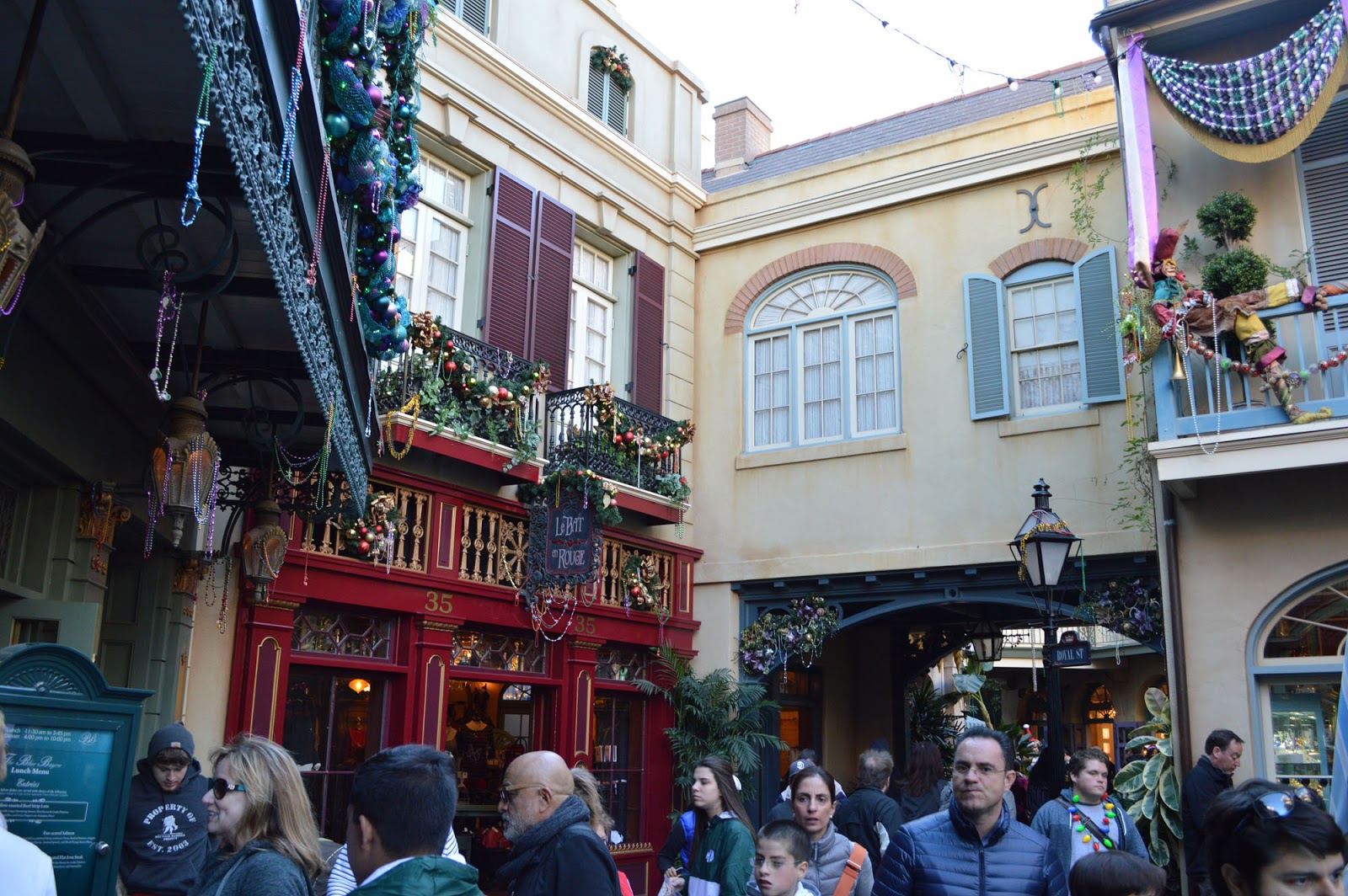
The other problem with this land is crowd flow. This land
appeared to have the narrowest walkways and the most bottleneck points, so it
became chaotic to get through the land. Specifically, the path past Haunted
Mansion towards Critter Country was nearly impossible. This might be a
challenge to fix, but I think it needs to happen. Crowds are growing, and it’s
becoming miserable and nearly dangerous to move through some of these areas. The
intersections with Adventureland and New Orleans Square was also bad because of
the entrance to Pirates.
So therefore, I never made it to Critter Country, so I don’t
have much a comment. I wasn’t upset by this, because it was too cold to ride
Splash Mountain and I wasn’t interested in Winnie the Pooh. I passed it by
train at least. I do hope that pathways can be reconfigured so that this area
is no longer as isolated.

Going back to Fantasyland. This was a large land with a lot
of good and classic attractions. I didn’t anticipate how lush and spread out
this land was compared to the other Fantasylands I have seen. It was as
sprawling as Paris but a fully grown forest, which made so big of an
environmental difference. It also meant each little area couldn’t see the rest
of the land, which kept the reveal of a sight like the Small World façade really
controlled and more effective.


I got to ride some classic dark rides that I had never seen
before, such as Toad, and ride familiar favorites like Snow White. My favorite
of the five however was Alice in Wonderland, just because of how unique it was
with the outdoor section. It was also fascinating to see the evolution of the
dark ride, from the painted flats in Toad, to full sets in Pinnochio, and then new
projection aided environments in Alice. I only wish that the projection face
figures had actually made their way into the dark rides.
The problem with Fantasyland is just like those before. Its
pathways cause a lot of congestion, but specifically at Parade time. The main
cross path from Fantasyland to Tomorrowland intersects the parade path and
causes traffic chaos with people trying to get from the left to the right side
of the park. This might be a place to look into a traffic flow solution. I also
think Fantasyland could do with an expansion of one or two more rides, possibly
in place of the Fantasyland Theater or into Toontown.

Toontown is another land I did not spend much time in because
of crowds and cold. Plus I wasn’t interested in the Meet and Greets or houses,
so I just made a quick walk through the land to see the architecture. It seems
to be a perfectly nice and well themed land that fulfills its purpose. If
needed for expansion, I don’t think it would be a big loss, but if it survives,
it works as a solid land in the park.

Last, we move onto the land with the most problems, but the
currently most popular attraction of the resort. Tomorrowland has some good
parts, but a lot of things that need adjustment and the potential for three or
four or more new attractions. Whereas the rest of the lands in the park seem to
have this innate history and resolved masterplan and organization, Tomorrowland
feels messy and temporary. I don’t want to be harsh, it is a good land at
times, but is far behind Paris, the best version of this type of land, and
Orlando, where there is a bit more organization. So I’m going to try to do a
lot to this land.


I should also talk about the Star Wars stuff too,
specifically Hyperspace Mountain. Wow that was cool and is a great example for
the draw of a Star Wars attraction. It consistently had the longest lines and I
never heard someone come off it disappointed. A permanent, well themed Star
Wars land is needed fast. And now that I have seen The Force Awakens, I see a
lot of potential and am very excited for where the these lands are going. I’m
also very glad for the decision to let Star Wars create its own land and not
overlay Tomorrowland.
Now across the Resort, we come to California Adventure. I
followed the expansions closely and was excited to see what exactly this park
had become. I was happily surprised by the total park experience and really
enjoyed my short time there. I say short because even with the additions, I
still could feel that this park hasn’t reached its potential. The new additions
were noticeably great but revealed just how much more work is needed to the unchanged
areas. Paradise Pier and parts of Hollywood need help next. Still, a relatively
solid park that is far better than Disney Studios Paris and a bit ahead of
Hollywood Studios. Also, I should say that there are much less traffic flow
issues here, likely because it was designed as a modern park with wide pathways
and no real bottlenecks.


Buena Vista Street is a very well designed entrance to the
park and a good companion to Main Street. I really enjoy the architecture and
tone of this time period, so I always knew I would like this street. Again, it
was nice to have the kinetics of the working Red Car Trolley and the various
performing groups. Somehow my entrances were timed so that I saw Five and Dime
perform about 6 times over a day and a half.


One strange comment about the land. I had the opportunity to
talk to a design professional and brought up how nice this land was. He
mentioned that the land actually looks a lot like many of the large outdoor
malls in southern California, like the Grove. The owner of the malls was a fan
of Disneyland and themed architecture, so his malls ended up being Main
Street-esque with a turn of the century Hollywood theme. And now, Buena Vista
Street was designed with the same theme, so consequently looks like a local
mall. How odd.

On to Hollywoodland, which has some really great parts and
some great potential for new additions. First, I love the architecture of the
main street, even with the fake street end mural. Next, I love the Aladdin
Musical and it is a crime that were losing it for more Frozen. Last, this
version of the Animation building is by far the best, especially because of the
central room with the projected montages.

Besides those things, this land has a lot of room for future change, mostly in the northern backlot style area. Monsters Inc. is a fairly good ride that can stay if thematically appropriate, but besides that, there is a lot of room here and three or four large soundstage showbuildings for additions. I think this half of the land is the prime spot for the next major addition to the resort.

Besides those things, this land has a lot of room for future change, mostly in the northern backlot style area. Monsters Inc. is a fairly good ride that can stay if thematically appropriate, but besides that, there is a lot of room here and three or four large soundstage showbuildings for additions. I think this half of the land is the prime spot for the next major addition to the resort.

A Bug’s Land, right between Hollywood and Carsland is
another nicely themed but low substance land. I understand its purpose was a
speedy addition of kid friendly rides to the thrill heavy park. I was actually surprised
at how nice and thorough the theming was, especially at night when the land
glows. Even so, this is a land that I would not have a problem with losing for
the sake of expansion to another land.

Carsland was highly anticipated and is obviously the high
point of the park, as it was always the most crowded. I’m not sure how I felt
about the land though. I might have built it up too much and it couldn’t have
delivered. That doesn’t mean its not good. The street was faithfully recreated
from the movie and really detailed and clever. The rockwork was breathtaking
and looked impossible. Radiator Springs Racers was fun, even if short, and had
the most impressive and source accurate animatronic figures I have ever seen
(specifically Mater – wow). But it still felt lacking as a total themed
environment. Maybe my best comment is that I distinctly heard many say “wow, it
looks just like the movie,” meaning its always going to just be a derivative
from the source movie, not a land with its own life.


The exception here is when the neon comes on and the sun
goes down. Then there is a whole new life to the land, and it is much more
kinetic, engaging, and interesting. Again, I don’t want to be overly critical. It’s
a good land and a great ride, but not a great headlining land that it is built
up to be.

Paradise Pier is the other land that has some flaws and
potential to grow. The only real problem here is that it is still mostly
carnival style rides that are not as unique as the rest of the park. Toy Story
is a good addition, and California Screamin is a fantastic coaster, but the
land could use one or two more non-spinner attractions. Expansion may be
possible underneath the coaster or on the west side, by the spinner rides.


Another interesting observation in this land is based on Toy
Story Midway Mania and The Little Mermaid dark ride. Both of these are clones
with attractions in Orlando and were both developed for both resorts at the
same time. Interestingly, both attractions were far better in California and
seemed to fit their surroundings infinitely better. Toy Story is themed as a
Midway game and set right in the middle of a Midway. Mr. Potato Head is designed
as a barker and here is actually placed as a barker. Little Mermaid was
designed as a basic but charming C or D ticket dark ride with a façade and
queue that doesn’t oversell it as the centerpiece of a huge expansion. It’s
almost like these attractions were designed for Disneyland and then just cloned
over to Orlando and stuck in where they fit the closest.

Last land, Grizzly Peak and the surrounding areas are a
really cool and really environmental land, again because of the trees and landscaping.
Trees and density are lacking in the rest of the park, but they make this land.
One problem here is the lack of attractions since there are really only two of
them, one when it is too cold for rafting, and then zero since Soarin is a
direct clone. This could do with another attraction to flesh out the national
park environment. However, I don’t believe there is much room.
Now that I’ve talked through both parks quickly, I have some
final comments comparing the resorts.
First, I have to mention the food. Disneyland food, from
snacks and counter service to table service, blows Disney World and Paris food
away. It is shocking how much better and how much more variety there is. Burgers
and chicken are not required to be on every menu apparently. Standout meals
were the sundried tomato and pesto chicken pasta at Paradise Pizza and Pasta,
and the ribs in Flo’s V8 Café. Both were counter service, served on real
plates, and reasonably priced. Table service was great too. I ate at Café Orleans
and Carthay Circle and both were great food for a theme park setting.
Another interesting comparison is the crowd distribution in
the resort. So I visited during a very busy time, not quite as bad as it will
be at Christmas, but pretty bad. But the actual queue times were not as bad as
an average day at Disney World. From what I can tell, this is both because
there are significantly more attractions to spread crowds, and less attractions
that use Fastpass, which usually always makes lines longer. This made a much
better park experience and it really makes sense. More rides equals shorter
lines, and this is one of Disneylands best strengths.
Last, the quality of the rides are almost universally better
at Disneyland. The rides are usually longer, like Pirates and Small World, have
more detailed sets and special effects, like Space Mountain and Buzz, and
better maintained, like many of the classic dark rides. Also, like I mentioned,
modern clones seem to make more sense there than at other resorts. The only
exception to this rule is Tower of Terror, which lacks a 4th
dimension room, and Haunted Mansion, which is shorter and less maintained.
Shows, including both the nighttime entertainment and the
traditional performances, are also much better. Part of this is just because many
shows are relatively new for the 60th and are often refreshed.
Mickey and the Magical Map was superior to any Orlando or Paris show just
because there was actually a cast of multiple live singers and a musician,
instead of just one or two. Aladdin was full Broadway quality and overshadowed
any other theme park performance. The street entertainment was varied and
impressive. Both World of Colors were technically impressive and pretty good
with content. Fantasmic had better scenes, was much closer and more intimate,
and an overall more impressive experience. And last, Paint the Night was a
truly modern response to the classic light parade typology. (I never saw
Disneyland Forever, so no comment there. It was cancelled every night I tried
to see it, or 4 of the 5 nights I was there.)
So in just about every way, Disneyland is a better resort.
So I immensely enjoyed both parks and don’t think there is a
huge amount of things that need to be changed. That doesn’t mean I’m not going
to try. I will be starting on a site plan soon, and will work on it through the
next weeks and months until I am happy with it.
For Disneyland, the main focuses are going to be
infrastructure and traffic flow changes throughout the park, a complete
reworking of Tomorrowland, and smaller additions in Fantasyland, Frontierland,
and maybe Critter Country. For Tomorrowland, a new consistent story and theme
will be an important first step. I would like to start it out original, without
an IP basis, but there are one or two IPs that I think could have a place in this
land, specifically Tron, one of my favorite fallbacks.
DCA needs more work, but doesn’t need any infrastructure
changes. The main addition I want to bring to DCA is a more structured park
identity that explains and supports the existing lands and suggests more additions.
For instance, I want to restructure the existing lands as manifestations of the
California spirits of adventure, creation, and fun (as in Grizzly Peak, Hollywood
and Cars Land and Marvel, and Paradise Pier). So with this new identity, I am
going to look into moderate additions in Grizzly Peak and Paradise Pier to flesh
out their themes, and major additions of Marvel and Pixar and possibly more to
the creation areas. This park has a lot of potential that I look forward to
figuring out.
Im excited to start work on this resort and excited to share
my ideas later this year. I’ll keep you updated as I put it together.
In the meantime, I’m still working on a new post for an
original attraction in EPCOT to be posted sometime in the next few weeks. And
then next year, we will continue with a new post a month.
As I am putting together my schedule for posts, I want to
hear what kinds of projects you want to see. I have a few posts started, including
attractions based on Indiana Jones, UP, The Incredibles, and Tangled, but want
your suggestions. Original attractions? Overlays? Park expansions? New Parks?
Any particular properties? Let me know in the comments, and I will take your
ideas into consideration.
Subscribe to:
Posts
(
Atom
)